Bundling rules specify how payers bundle multiple services into a single claim payment rather than reimbursing each service separately. CMS serves as the primary authority for establishing bundling guidelines under its National Correct Coding Initiative (NCCI).
However, commercial payers such as Aetna, UnitedHealthcare, Cigna, and Blue Cross frequently implement payer-specific bundling edits that directly affect claims reimbursement.
The rules these agencies have created make bundling one of the most unpredictable areas of medical billing; two identical claims can yield two different claim reimbursement amounts from a payer.
Bundling essentially means that certain procedures, when performed together, are considered part of a single comprehensive service and not separately billable. Payers have layered their own automated logic into claim processing that goes beyond CMS rules, leaving billers often guessing why claim reimbursement was reduced or denied altogether.
Why It Matters
Variations in bundling by payer lead to claim reimbursement losses that most practices never realize. A claim may be marked “processed as bundled” with no clear explanation, resulting in underpayments that quietly accumulate over time.
It is essential to understand how each payer 'bundles' services not only from a perspective of maximizing claim reimbursement but also compliance because improper unbundling (or "unbundling fraud") can lead to audits and penalties under CMS or other payer compliance programs.
Key Challenges in Payer-Specific Bundling Rules
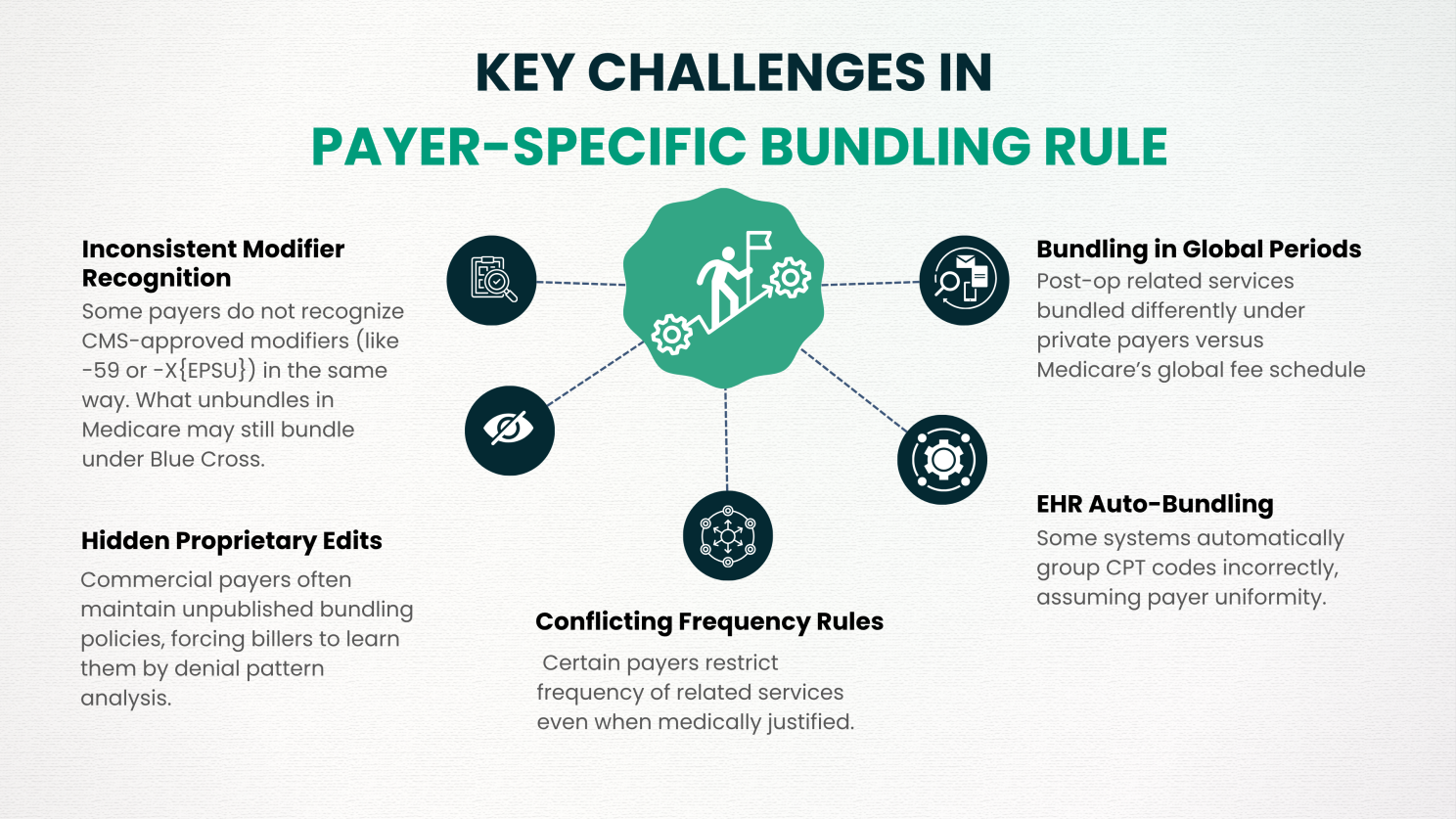
Key Challenges in Payer-Specific Bundling Rules
Hidden Proprietary Edits: Commercial payers often maintain unpublished bundling policies, forcing billers to learn them by denial pattern analysis.
Inconsistent Modifier Recognition: Some payers do not recognize CMS approved modifiers (such as 59 or X {EPSU}) consistently. What unbundles in Medicare may still bundle under Blue Cross.
Conflicting Frequency Rules: Certain payers restrict the frequency of related services even when medically justified.
EHR Auto-Bundling: Some systems automatically group CPT codes incorrectly, assuming payer uniformity.
Bundling in Global Periods: Post op-related services are bundled differently under private payers than under Medicare’s global fee schedule.
Real-World Examples
When modifier 25 is used, a Medicare claim for a stable procedure with an E/M visit on the same day receives full claim reimbursement. But UnitedHealthcare refuses to reimburse the same claim as bundled, citing a proprietary edit that the E/M was not “significant and separately identifiable.”
Aetna may include certain modalities (e.g., hot/cold packs) in packages with therapeutic exercise and lower reimbursement pot on claims; however, Cigna pays separately as long as documentation suggests that the modalities were clearly identifiable additional needed services.
A surgical practice keeps getting claim reimbursement denied for wound debridement and dressing changes because their payer bundles these automatically under the primary surgical CPT code, even though CMS does not have a rule to do this.
Compliance & Regulatory Considerations
1. NCCI Edits (CMS):
Still a must for reimbursement of claims from Medicare and Medicaid, specifying which CPT/HCPCS codes cannot be billed on the same claim.
2. Commercial Payer Adaptations:
Each payer builds its own bundling engine from utilization data and cost containment algorithms, which introduces variation in claim reimbursement that billers must monitor independently per payer.
3. HIPAA & Transparency Mandates:
New mandates transparency laws from payers (2024–2025) require payers to disclose, on remittance advice, the rationale for bundling, but these mandates are often weakly enforced, leaving the provider community with a limited view of decisions related to claim reimbursement.
4. Right to Appeal:
Providers maintain their right to appeal bundled denials, as well as all other denials, under CMS and state insurance laws, provided clinical opportunities exist that support separate claim reimbursement.
Best Practices to Protect Claim Reimbursement
1. Maintain a Payer Specific Denial Log:
Track denials by payer and code combination to identify bundling trends that are suppressing claim reimbursement.
2. NCCI Tables Comparison:
Identify whether the bundling is payer-specific or based solely on NCCI before appealing reduced claim reimbursement.
3. Use Documentation to Support Separation:
Each service rendered must be documented at the time of service and, where necessary, with diagnosis codes that support separate services to ensure they can be fully reimbursed on the claim.
4. Employ Appropriate Modifiers:
Use 59, 25, or X{EPSU} as justified, not automatically. One of the surest ways to lose out on claim reimbursement is incorrect modifier use.
5. Conduct Audits of the Regular Payer Rule:
Advisory organizations tend to update their payers’ policies quarterly, and the bundling logic changes overnight without notice, directly affecting carry-forward claim reimbursement.
6. Train Your Staff on More than Medicare Logic:
Commercial payers are often out of line with CMS; thus, billers must understand both systems to consistently shield claim reimbursement across all payer types.
7. Appeal Strategically:
Use medical necessity, time spent, and payer policy contradictions to overturn inappropriate bundling and recover lost claim reimbursement.
Key Takeaway
The bundling issue for specific payers is not a technology problem; it is a strategic challenge that needs constant monitoring to ensure claim reimbursement at all stages. The biller who knows the payer-level behavior is no longer a claim processor; they are now a claim reimbursement defender.
Practices that remain mindful of denial intelligence and customize documentation to each payer’s bundling rules can recoup 5–15% of claim reimbursement losses that would otherwise go unclaimed.