Contract Management & Payer Negotiation in Healthcare
Why Your Payer Contracts Matter More Than Your Billing Team
The Revenue Problem That Does Not Start in Billing
When margins shrink, most healthcare leaders audit billing first. They review Denial Rates, Coding Accuracy, AR days, and Clean Claim Rates. Those metrics matter, but they often hide a bigger problem.
A healthcare practice can have perfect coding, zero denials, and a world class billing team, still lose 3% to 7% of revenue every year.
The reason is Contractual, not Operational.
Every claim you submit is paid based on terms you negotiated years ago. Those terms define Covered Services, Reimbusement Rates, Authorization Rules, Payment Timelines, Appeal Rights, and how Disputes get resolved. If those terms are weak, your billing team is just executing on a bad deal.
In most healthcare organizations, contracts are signed, filed, and forgotten until renewal. Meanwhile, revenue cycle teams fight to collect money based on rules they have never read. That disconnect is one of the largest unaddressed sources of margin erosion in healthcare today.
Contract management is not legal housekeeping. It is financial strategy.
1. What a Payer Contract Actually Controls
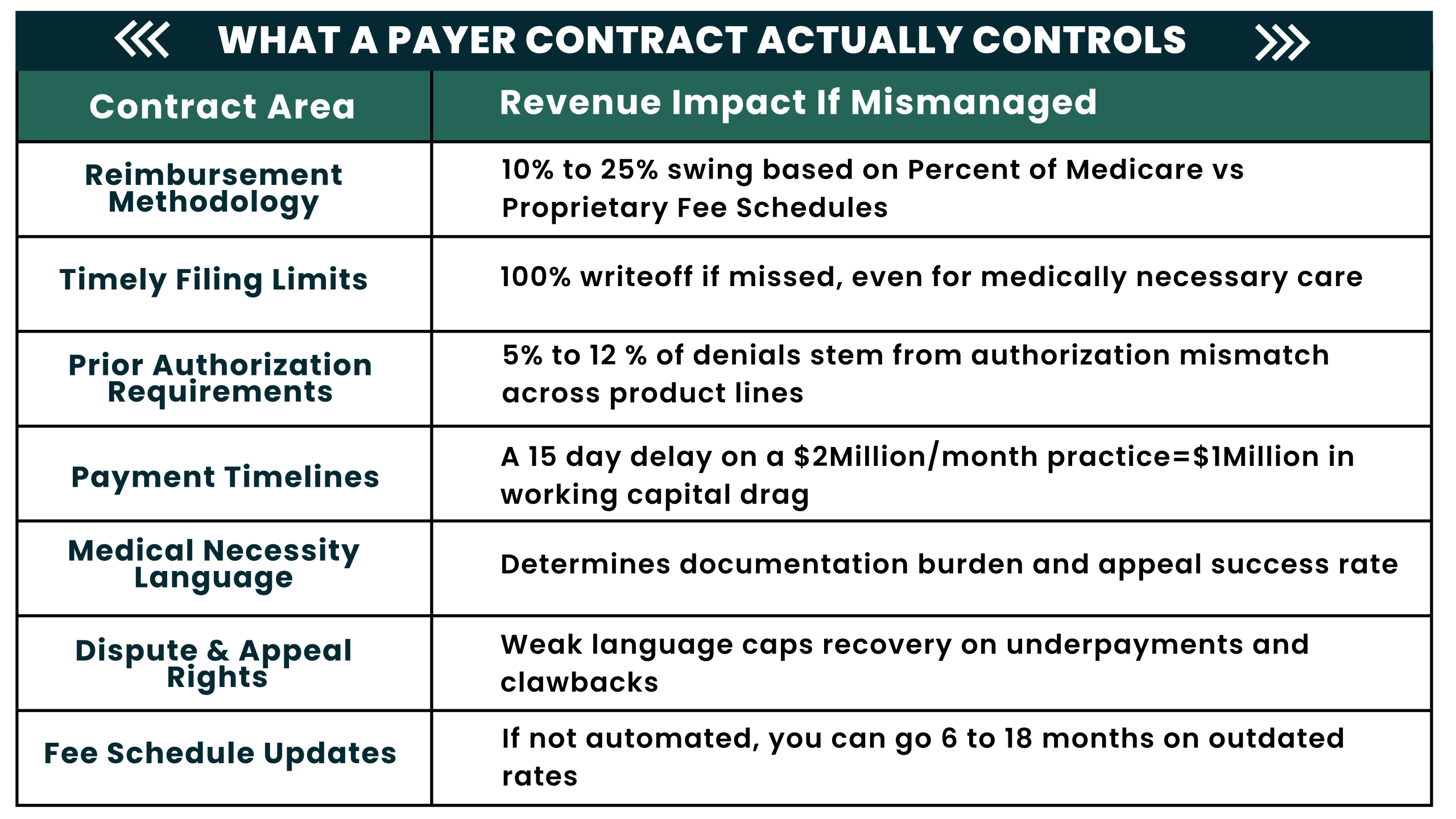
A payer contract is the operational playbook for your entire healthcare revenue cycle. It dictates:
Two cardiology groups in the same ZIP code can be paid differently for the same CPT code. The difference is not billing. It is the Contract.
2. Why Contract Management Got Harder
Reimbursement in healthcare used to be simple Fee for Service and a Rate Sheet. But today you are managing:
Hybrid Models: FFS plus case rates plus bundles plus shared savings plus quality bonuses
Product Fragmentation: Same payer, different rules for PPO, HMO, Medicare Advantage, Medicaid MCO
Policy by Reference: Contracts incorporate 200 page medical policies you never negotiated
Value Based Risk: Upside bonuses tied to quality and cost, with downside risk if you miss targets
You cannot understand financial exposure by looking at rates alone. You have to model how all provisions interact across episodes of care.
3. The Hidden Cost: What Poor Contracts Actually Do
Bad contracts do not show up as a line item. They bleed healthcare organizations slowly.
Common Leakage Patterns
Silent Underpayments: Payer reimburses at 80 percent of contracted rate. Without expected reimbursement logic, you never catch it. Annual loss: 1.5 to 4 percent of collections.
Authorization Denial Loops: Contract says auth required for MRI. Payer’s portal says no auth needed. You get denied anyway. Appeal rights are weak, so you write it off.
Stale Fee Schedules: Medicare updates rates every January. Your contract says you get 110 percent of Medicare. Payer delays loading new rates until July. You just gave a 6 month discount.
Renewal By Default: Auto-renew clauses keep bad terms alive. No data means no leverage, so you accept 1 percent increases while costs rise 6 percent.
Quantify it: For a 100 physician group collecting $80M annually, a 2 day increase in payment lag costs $438,000 in AR carrying cost at 10% cost of capital. A 3% underpayment rate is $2.4M left on the table.
4. The 5 Clauses Executives Must Audit This Quarter
Do not wait for renewal. Audit these now.
Reimbursement Methodology and Escalators
Is it percent of current year Medicare, or a fixed 2019 fee schedule? Do you have annual escalators tied to CPI or Medicare updates? No escalator means real rates decline every year.
Timely Filing and Reconsideration
Standard is 90 to 180 days for initial claim, 60 to 120 days for appeals. Anything tighter is high risk. Ensure the clock starts at “receipt of remit” not “date of service.”
Lesser-of Language
“We pay lesser of billed charges or contracted rate.” If your chargemaster is low, you capped yourself. Negotiate carveouts or update charges before signing.
Material Change Notices
Payers can change policies with 30 days notice. Push for 90 days and “mutual agreement for material financial changes.” Otherwise your contract terms can shift mid year.
Termination and Network Adequacy
Know your out. 90 day without cause termination gives leverage. Also check if you are critical for network adequacy. If you are the only oncology group in the county, you have power.
5. Payer Negotiation: How, When, and Why Payers Push Back
Most healthcare providers negotiate on rate alone and lose. High performing organizations negotiate on total contract value.
Why Payers Are Reluctant?
Understand their incentives so you can counter them:Understand their incentives so you can counter them
Medical Loss Ratio Pressure: MA and commercial plans must spend 80 to 85 percent of premiums on care. Every dollar to you is a dollar from their margin.
Budget Silos: The negotiator you meet does not control auth policies or claims ops. They can give rate but cannot fix operations without internal escalation.
Network Optics: They need to show regulators a complete network. Dropping you looks bad. But they will not volunteer that.
Data Asymmetry: Payers have your utilization, cost, and quality data. If you walk in without your own analytics, you are negotiating blind.
When to Negotiate
Do not wait for renewal dates. Trigger events include
12 months before auto renewal deadline
Service line expansion: New physicians, new location, new technology
Volume shifts: You now control 30 percent of market share in a specialty
Consistent underpayments or auth friction documented over 2 plus quarters
Payer M&A or product changes in your market
First Time Negotiators: Start 18 months before your largest contract expires. You need time to gather data and build leverage.
How to Negotiate
Phase 1: Build Your Case, 6 to 12 Months Out
Pull Your Data: Procedure volumes, payer mix, denial rates, AR days, underpayment rates by CPT, cost per case. Know your cost to deliver care.
Model the Ask: “We need 108 percent of Medicare for CPT 99214 to cover cost plus 5 percent margin.” Bring the math.
Document Friction: Track every auth delay, peer-to-peer hour, and wrongful denial. Time is money. Show the admin cost they impose.
Know your Value: Low readmission rates, high patient satisfaction, ED diversion, coverage in underserved ZIP codes. If you leave network, their members drive 40 miles. Use it.
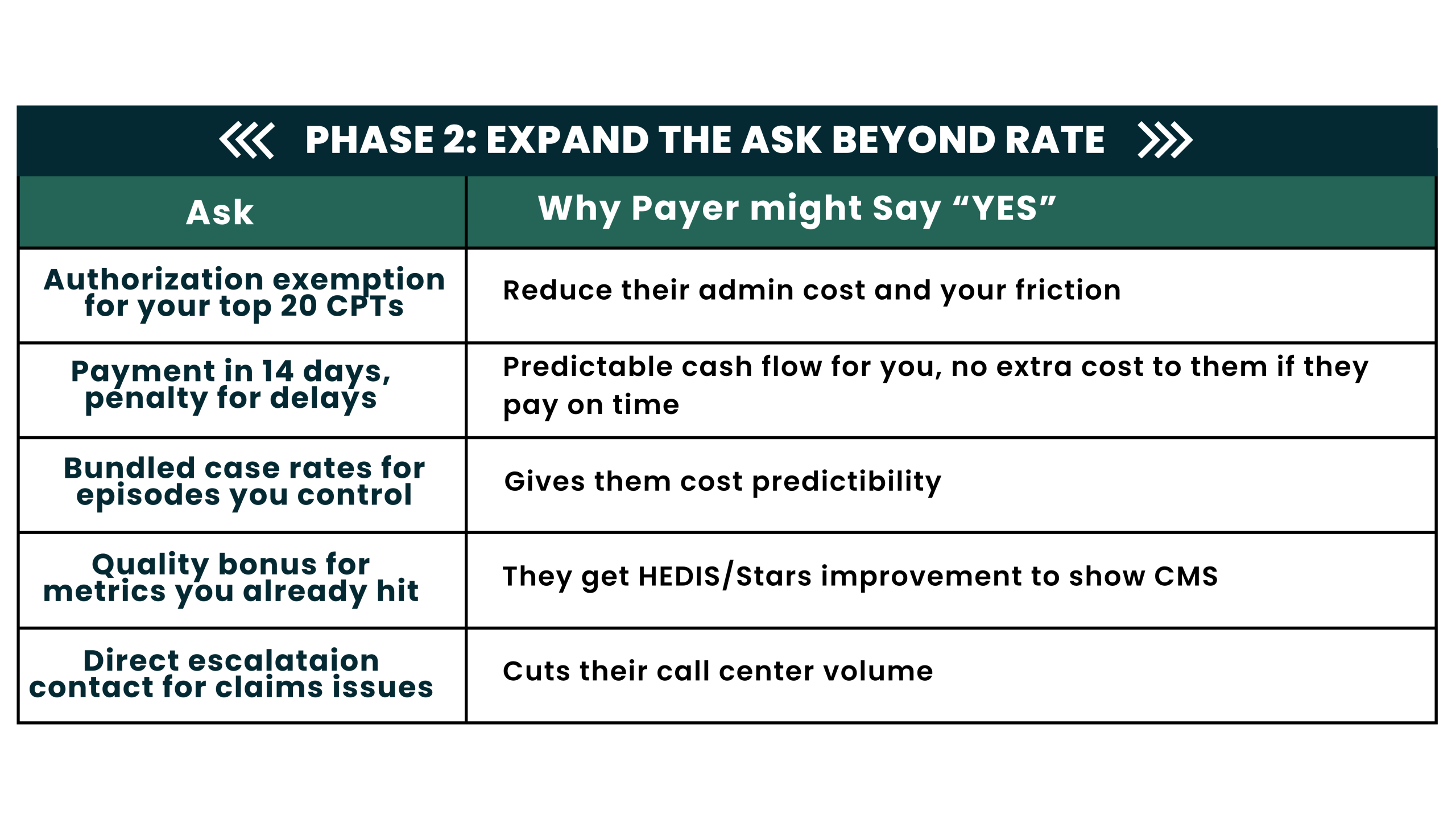
Phase 2: Expand the Ask Beyond Rate
Rates are Zero-Sum. Operations are Win-Win. Negotiate:
Phase 2: Expand The Ask Beyond Rate
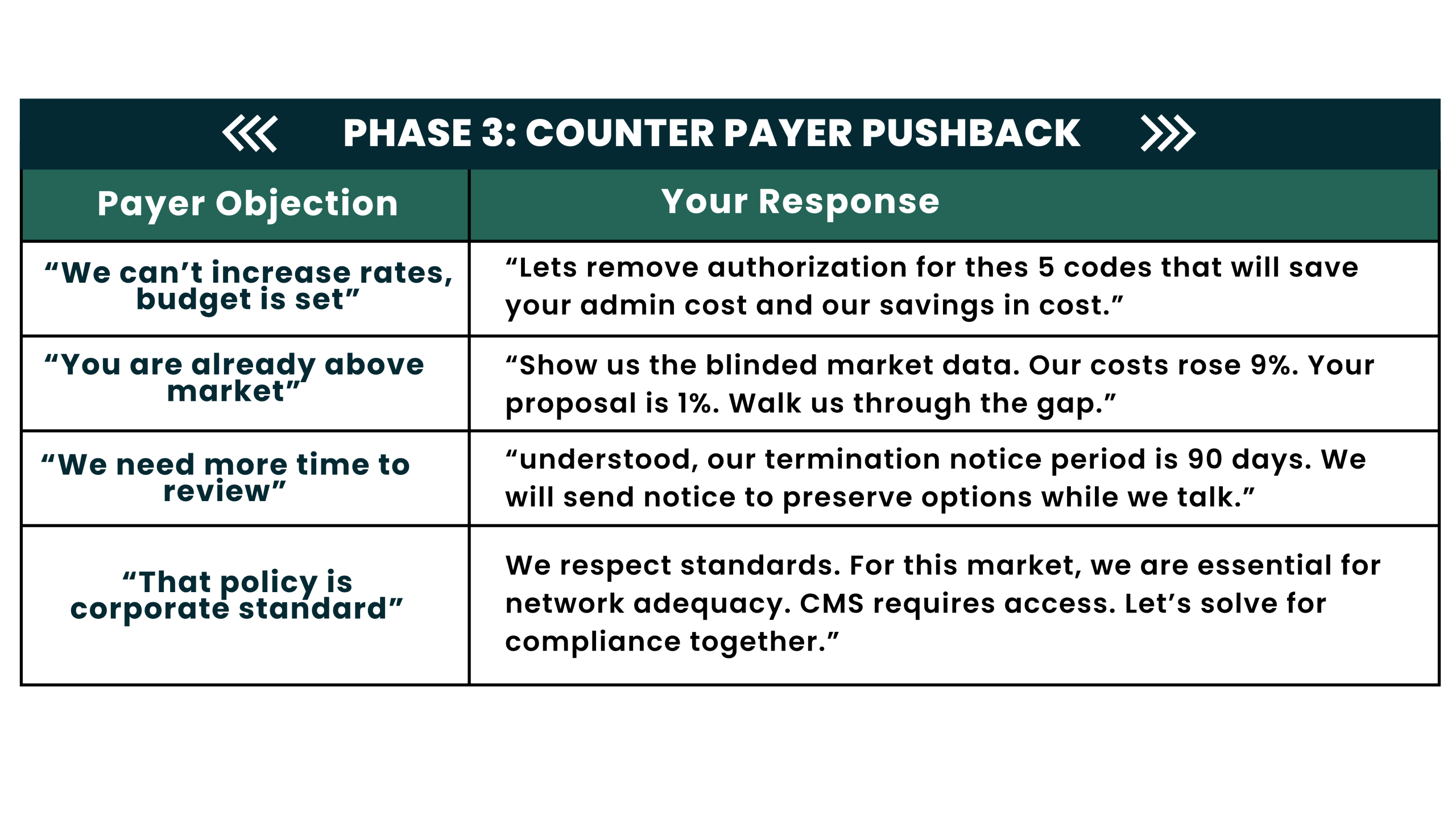
Phase 3: Counter Payer Pushback
Phase 3: Counter Payer Pushback
First Time Negotiator’s Special Rules
Do not go alone: Hire a managed care attorney or consultant for your first 1 to 2 contracts. The cost is small vs a 5 year bad deal.
Start small: Pick your smallest payer first. Learn the process before you touch the 40 percent of revenue contract.
Never accept “standard template”: Everything is negotiable. If they say it is not, that is a negotiation tactic.
Get it in writing: Verbal promises from reps mean nothing. If it is not in the redlined contract, it does not exist.
Walkaway power: If you cannot afford to lose the contract, you cannot negotiate it. Build cash reserves or align with an IPA before you start.
6. Value Based Contracts: Opportunity vs Risk
Payers are shifting risk to healthcare organizations through shared savings, bundles, and capitation. The upside is real, but only if you control 3 things:
Data: You need real time cost and quality tracking. If you get reports 6 months late, you are flying blind.
Documentation: Risk adjustment and quality scores depend on HCC coding and clinical documentation. CDI is now a revenue function.
Exit Ramps: Negotiate downside caps and opt-out clauses. A bad year should not bankrupt healthcare practice.
Do not sign risk until you can measure it.
7. Real World Example: Two Practices, Two Outcomes
Practice A reviews contracts quarterly. They track underpayments, model expected reimbursement, and enter renewals with a 40 page data packet. They negotiate authorization exemptions and 14 day payment terms.
Practice B signs what the payer sends. They focus on billing speed.
After 5 years, Practice A has 12% higher net revenue per physician, 22 fewer AR days, and 60% less admin time spent on appeals. Same specialty, same market.
The difference was not billing. It was the contracts.
8. The Future is Data Driven Contracting
Manual contract review is dying across healthcare. Leading organizations now use:
Contract Modeling Software: Simulate impact of rate changes before you sign
Payment Variance Engines: Flag every underpayment automatically
Payer Scorecards: Track denial rates, pay speed, and admin burden by payer to prioritize who to renegotiate or terminate
AI Clause Analysis: Flag risky language like “lesser-of” or unilateral policy changes
But tech is not strategy. You still need consultants who understand that healthcare contracts are financial instruments, not legal paperwork.
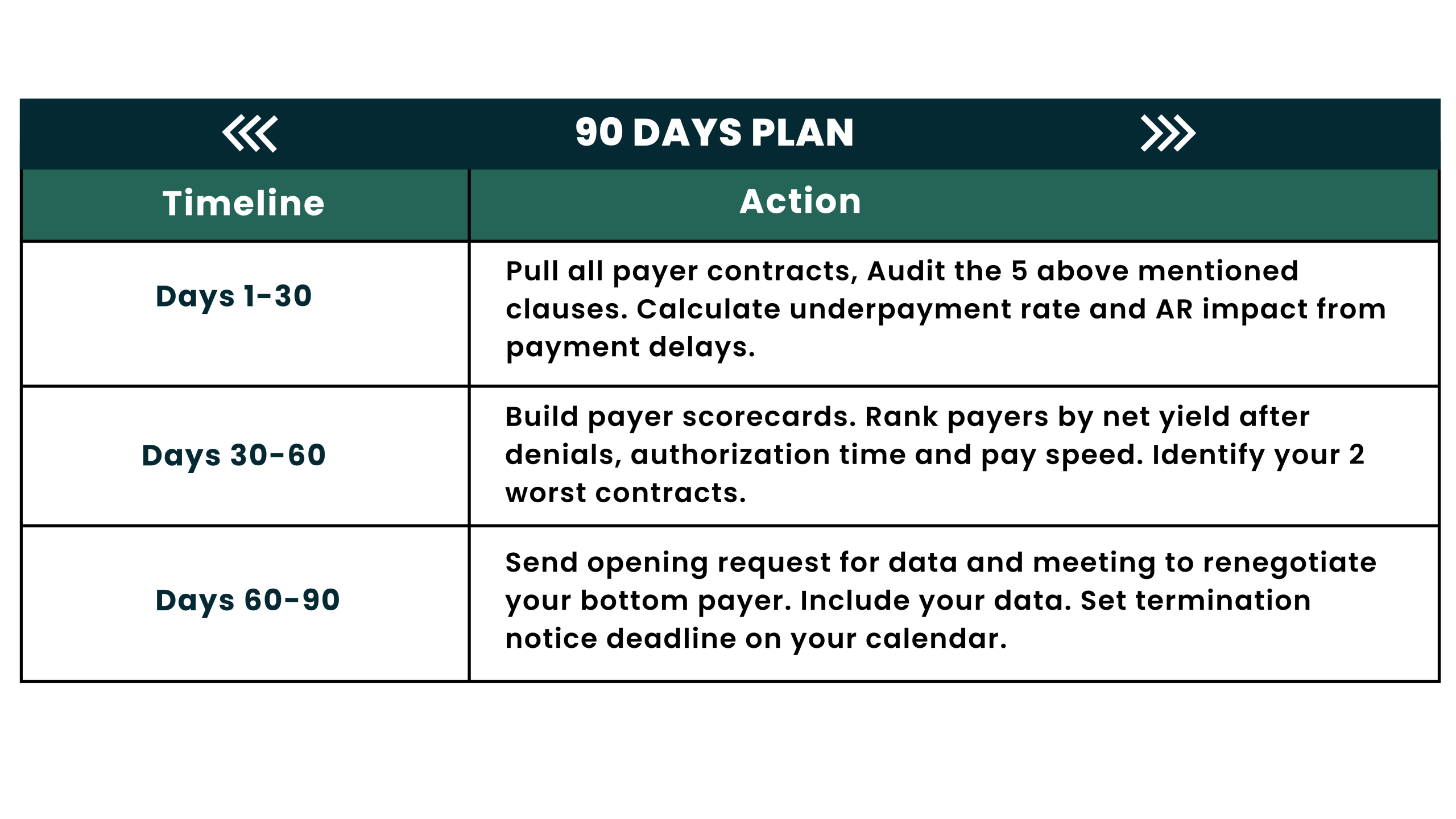
Strategic Takeaways
Strategic Takeaways: 90 DAYS PLAN
Your billing team optimizes within the walls of your healthcare contracts. If those walls are poorly built, you will never collect what you earned.
The strongest revenue cycle does not start in the billing office. It starts at the negotiation table, where every future claim is priced.
In healthcare, you do not get what you deserve. You get what you negotiate.