
Coordination of Benefits (COB) is one of the most important and frequently misunderstood components of the U.S. medical billing revenue cycle. When a patient has two or more insurance coverages, simply identifying the insurance cards is not enough. The provider must determine
A COB error can cause a claim to be rejected before adjudication, denied after adjudication, routed to the wrong payer, incorrectly transferred to patient responsibility, or left sitting in A/R while the billing team attempts to determine who should pay.
At its core, COB answers one question
When more than one payer may be responsible for a patient's healthcare expense, who pays first, who pays next, and how much does each payer owe?
CMS defines COB as the process used to determine the respective payment responsibilities of multiple health plans and ensure that the appropriate payer pays first.
Coordination of Benefits (COB) is the administrative and adjudication process used when an individual has coverage under more than one health plan or insurance arrangement.
The process establishes
The payer that processes the claim first is generally referred to as the primary payer.
The next payer is the secondary payer.
If another payer remains after the secondary payer, it may be referred to as the tertiary payer.
However, the presence of multiple insurance cards does not automatically determine payer order. Payer order is established according to applicable federal rules, plan provisions, contractual rules, state requirements, and the specific circumstances of the patient’s coverage.
COB affects virtually every major stage of the revenue cycle.
A COB error can begin at Patient Registration → Eligibility → Claim Submission → Adjudication → Payment Posting → Secondary Billing → A/R Follow-Up → Patient Collections
For example
A patient presents two insurance cards. The front desk assumes Insurance A is primary. The claim is submitted to Insurance A.
Insurance A determines that it is actually secondary and denies the claim.
The billing team then submits to Insurance B. Insurance B may also deny because its system expects another payer to process the claim first.
Now the account requires
What initially looked like a simple eligibility issue has become a revenue cycle problem.
This distinction is critical.
Does the patient have active coverage with this payer for the date of service (DOS) ?
If the patient has multiple coverages, which payer is responsible first?
A patient can have
and still have the claim denied because the provider billed the wrong payer first.
Therefore
Eligibility ≠ COB determination.
A robust eligibility process should identify both.
The primary payer has first responsibility for processing the claim. The provider normally submits the claim to the primary payer first.
The secondary payer evaluates the remaining liability after the primary payer has adjudicated the claim. The secondary claim generally contains information about the primary payer’s adjudication.
A third payer may be responsible for remaining allowable amounts after primary and secondary adjudication.
The exact payment responsibility depends on the payer’s contract, benefit design, COB methodology and applicable rules.
A professional COB workflow looks like this
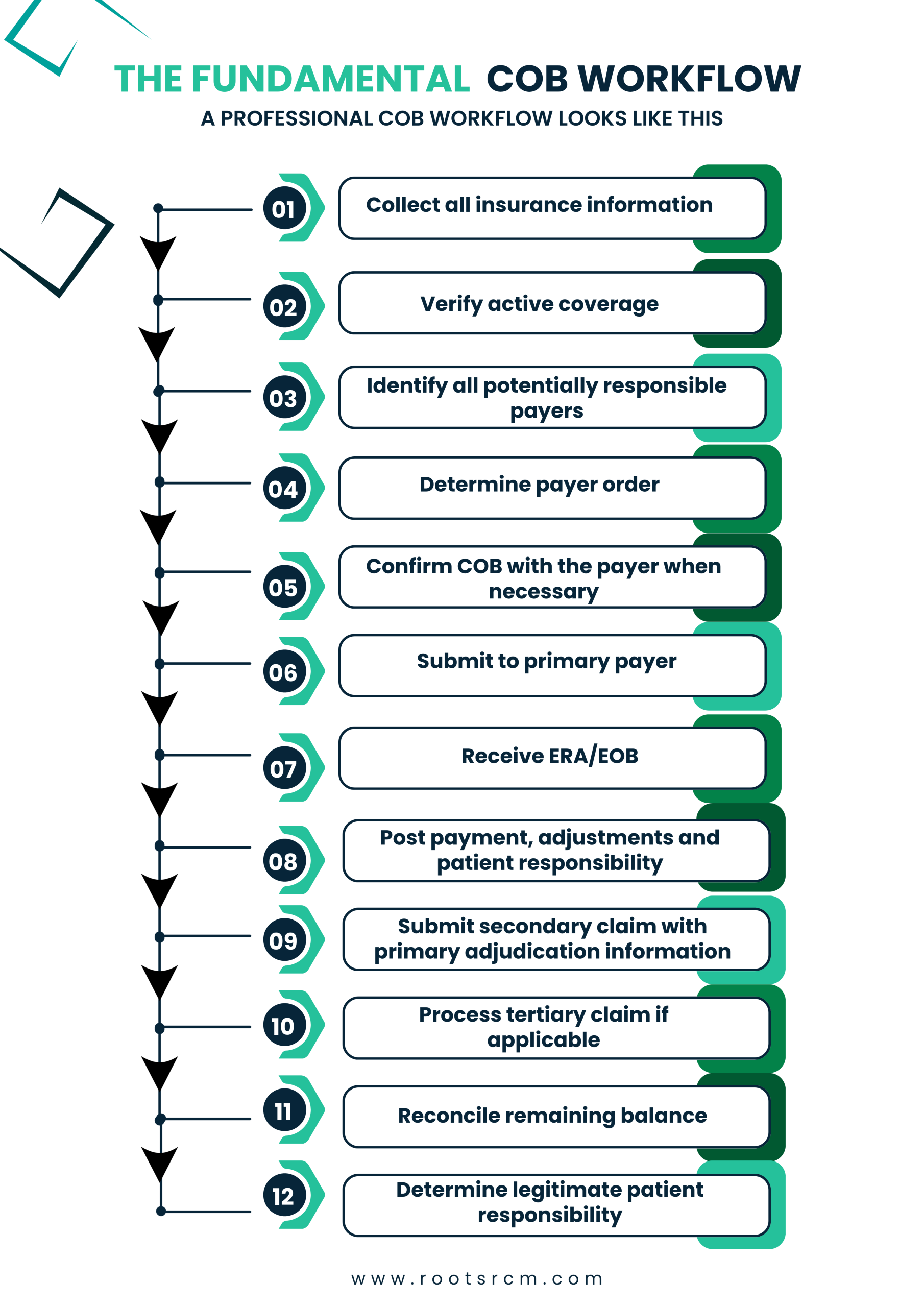
This process should be documented in the practice management system.
“More volume can actually worsen financial performance when the economics of the additional volume are unfavorable”.
A patient may have multiple sources of coverage because of
Medicaid specifically recognizes numerous potential third parties, including group health plans, self insured plans, Medicare, workers compensation, liability settlements and other coverage sources.
This is where experienced billing professionals distinguish themselves from basic eligibility staff.
The answer cannot always be determined from the insurance cards. You must understand why the patient has each coverage.
For example
These facts can completely change payer order.
COB becomes particularly important when Medicare is involved. The Medicare Secondary Payer (MSP) rules determine circumstances in which Medicare does not have primary payment responsibility.
Federal law requires entities billing Medicare to determine whether Medicare is primary for the services being billed.
Common MSP situations include
One of the most important Medicare COB rules concerns beneficiaries age 65 or older who have employer group health coverage.
For a beneficiary age 65+
Generally
Medicare → Primary
Employer GHP → Secondary
Generally
Employer GHP → Primary
Medicare → Secondary
CMS specifically identifies the 20 employee threshold for the working aged MSP rules.
Do not determine Medicare payer order merely from “Patient has Medicare.”
You need to understand the source of the other coverage and the applicable MSP rules.
For individuals entitled to Medicare because of disability, different MSP rules apply. Where the beneficiary is covered by a Large Group Health Plan (LGHP) through current employment or a family member’s current employment, the employer plan may be primary.
CMS identifies the relevant large employer threshold as 100 or more employees for disability MSP situations.
Therefore, the billing team must distinguish
Medicare due to age
from
Medicare due to disability
because the payer order analysis can be different.
ESRD creates another highly specialized COB situation. During the Medicare ESRD coordination period, a Group Health Plan may be primary and Medicare secondary.
CMS identifies a 30-month coordination period for ESRD MSP.
This rule is particularly important for dialysis providers, nephrology practices, hospitals and other providers treating patients with ESRD.
A billing specialist should therefore determine:
If a Medicare beneficiary receives treatment for a work related injury or illness covered by worker’s compensation then worker’s Compensation generally pays first.
Medicare may pay conditionally in circumstances where worker’s compensation is not expected to pay promptly, subject to subsequent recovery.
This creates an important distinction that Conditional Medicare payment does not necessarily mean Medicare ultimately bears financial responsibility.
Medicare may later seek reimbursement when another payer becomes responsible.
When a Medicare beneficiary receives treatment related to an accident, Liability/No fault insurance may be primary for accident related services.
Medicare may become secondary or make a conditional payment depending on the circumstances.
CMS advises reporting automobile accidents, liability situations and related legal actions because they can affect Medicare’s payment responsibility.
Medicaid operates somewhat differently from commercial COB. Medicaid is generally the payer of last resort. This means other legally responsible third parties generally must pay before Medicaid.
CMS describes this responsibility under Medicaid Third Party Liability (TPL).
States are required to take reasonable measures to identify third parties legally responsible for payment.
Potential Medicaid third parties include
• Commercial insurance
• Employer plans
• Medicare
• Workers’ compensation
• Liability insurance
• Court ordered coverage
• Other applicable government programs
Practical consequence
If a Medicaid claim is submitted without properly accounting for known third party coverage, the claim can encounter significant payment problems.
A patient may have both Medicare and Medicaid. This does not mean both plans simply split the bill 50/50.
The applicable Medicare and Medicaid rules determine responsibility.
In many dual eligible situations, Medicare processes covered services first and Medicaid may have responsibility for certain remaining amounts subject to applicable Medicaid rules and the individual’s Medicaid category.
Billing staff must therefore distinguish
• Medicare
• Medicare Advantage
• Medicaid
• Medicaid MCO
• QMB status
• Other Medicare cost sharing protections
• Supplemental coverage
Multiple commercial plans create another major COB category.
Examples
Patient’s employer plan + Spouse’s employer plan
or
Two employer sponsored plans
The applicable COB methodology determines which plan is primary.
The practice should not simply assume that “The policy with the earliest effective date is primary.”
That is not a universal rule. Plan documents and applicable COB rules must be followed.
Dependent children covered under both parent’s plans can create complex payer order questions.
A common COB methodology uses the birthday rule, under which the plan of the parent whose birthday occurs earlier in the calendar year is generally primary.
However, billing teams should not treat the birthday rule as an unconditional nationwide rule. Plan documents, applicable state requirements, custody arrangements, court orders, separation/divorce provisions and other circumstances can alter the analysis.
Therefore use the birthday rule as a methodology, not as a substitute for verifying the actual plan rules.
COB becomes significantly more complicated when a child is covered by parents who are
A court order or plan provision can affect payer responsibility. Therefore, the billing team may need to verify
COBRA is often misunderstood in COB analysis. COBRA is continuation coverage, but its presence does not automatically make it primary.
CMS provides specific MSP treatment for Medicare beneficiaries with COBRA coverage. For example, Medicare generally pays primary for beneficiaries age 65+ or disabled when COBRA is involved, while COBRA may be secondary. ESRD has separate rules during the 30 months coordination period.
Retiree coverage also has specific Medicare coordination implications. For example, CMS states that Medicare generally pays primary for beneficiaries age 65+ with employer retiree coverage, with retiree coverage secondary.
This is where COB becomes a claims processing discipline, not merely an insurance verification task.
Suppose provider charges $1,000
Primary payer adjudicates
The secondary payer receives the primary adjudication information and determines whether it has additional responsibility.
The secondary payer does not simply pay the entire $200 automatically.
Secondary payer’s own
must be applied.
The secondary payer generally needs the primary payer’s adjudication information.
The billing team should capture
A secondary claim without correct primary adjudication data can fail even when both insurances are active.
COB is deeply integrated into HIPAA standard electronic transactions. CMS states that the HIPAA adopted ASC X12N 837 standard contains requirements for electronic coordination of benefits claims.
The secondary claim needs the appropriate information representing the prior payer’s adjudication.
Conceptually:
Primary Claim → Primary Adjudication→Secondary COB Claim→ Secondary Adjudication→ Tertiary Claim if applicable
This is why a billing system must correctly capture and map primary EOB/ERA information into the secondary claim.
The electronic payment side is equally important. The practice may receive an 835 Electronic Remittance Advice (ERA) from the payer.
The ERA provides information used for
A poorly configured posting workflow can create a downstream COB problem even when the claim was correctly adjudicated.
This distinction matters.
A claim may be rejected because it fails electronic or front end validation.
Examples may include
The claim may never reach payer adjudication.
A claim reaches adjudication but the payer refuses payment or determines that the payer is not responsible.
Examples:
The correction strategy is different for each.
Some of the most common include:
The payer’s records indicate another plan should pay first.
The payer cannot determine responsibility.
The claim was sent to secondary before primary.
Secondary payer requires evidence of primary adjudication.
Amounts transmitted on the secondary claim do not match the primary EOB.
The payer’s eligibility file shows inactive coverage.
The payer has outdated COB information.
The payer’s system still identifies another insurance as primary.
Medicare determines another payer has primary responsibility.
The service is related to an accident or work injury.
The service is related to an accident or work injury.
An insurance card tells you who the payer is.
It does not necessarily tell you who pays first.
This is one of the most important operational lessons in COB. A professional billing operation should verify payer responsibility through:
At registration or eligibility verification, you should ask these questions
These questions can prevent significant downstream A/R problems.
A strong eligibility verification report should ideally capture
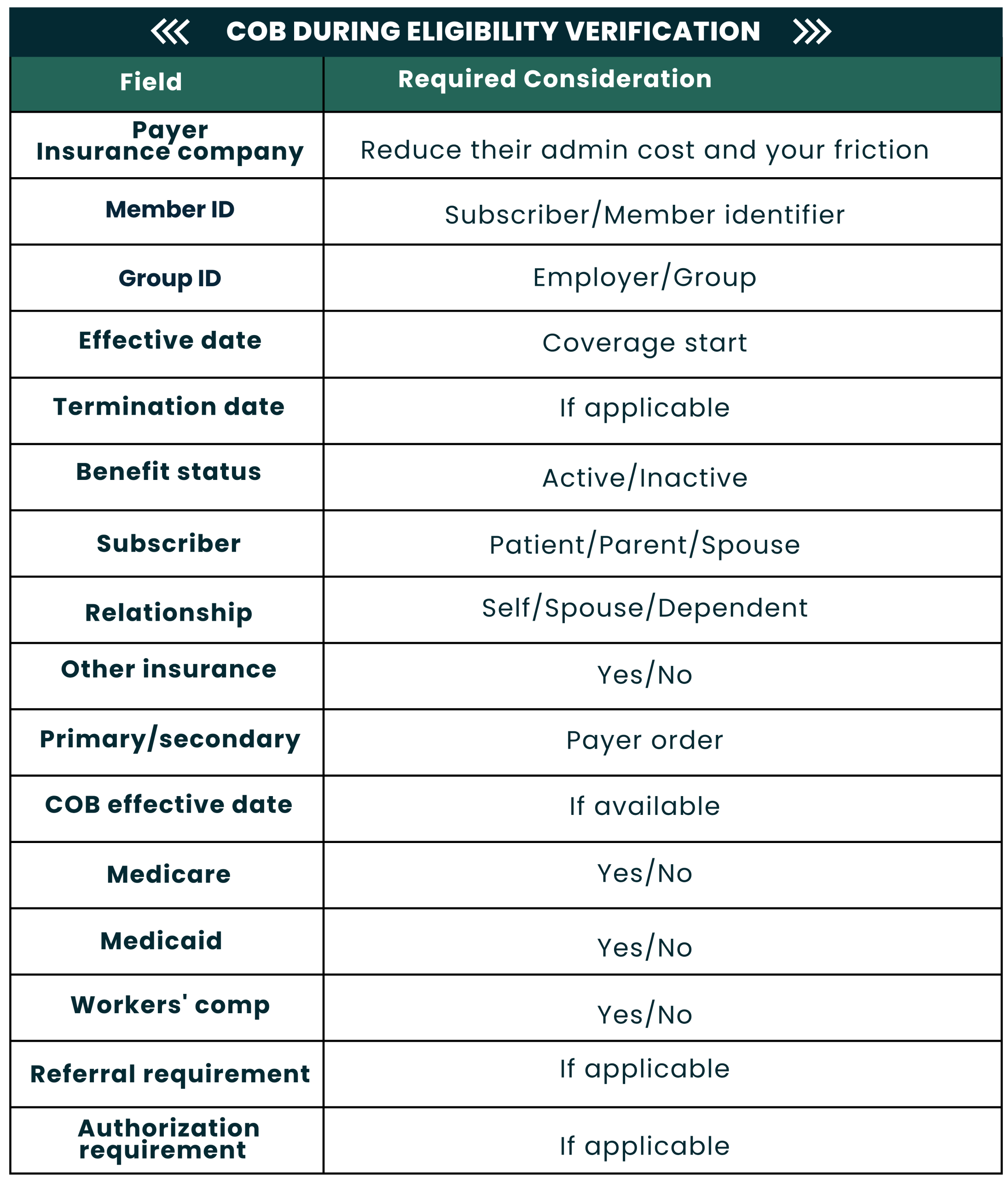
One of the biggest operational errors is assuming that payer order remains unchanged indefinitely.
COB can change because of
CMS specifically emphasizes that Medicare coverage information should be updated when other health insurance changes.
Therefore:
COB should be revalidated whenever there is a reasonable trigger for a change, not merely once per year.
Medicare has mechanisms for transmitting Medicare paid claim information to participating secondary insurers.
CMS’s Coordination of Benefits Agreement (COBA) program establishes standardized arrangements for transmitting Medicare eligibility and paid claim information to participating organizations.
This can facilitate secondary processing. However never assume every secondary claim will automatically cross over.
CMS notes that an agreement must exist between the BCRC and the private insurer for automatic crossover. Without the appropriate arrangement, additional coordination may be required.
These entities are frequently confused.
The BCRC manages activities related to identifying and coordinating other insurance coverage for Medicare beneficiaries. It does not process ordinary claims.
MACs process Medicare claims, including claims where Medicare is primary or secondary.
CMS explicitly distinguishes the BCRC’s COB role from the MACs’ claim processing responsibilities. This distinction matters when deciding who to contact.
Another major mistake is automatically transferring every unpaid amount to the patient. After primary and secondary adjudication, the remaining balance must be evaluated.
The billing team should determine whether the amount is
The fact that a secondary payer did not pay does not automatically make the balance patient responsibility.
Suppose provider charge $500
Primary allowed amount $350
Primary payment $250
Contractual adjustment $150
Remaining balance $100
The secondary payer may have responsibility for some or all of the remaining $100 depending on its COB methodology.
The billing team must avoid
COB is designed to coordinate payment rather than create duplicate reimbursement.
CMS explains that its COB process is designed to prevent payments from exceeding the total claim liability/benefit amount in dual coverage situations.
But this does not mean:
Primary + Secondary payment must always equal the provider’s billed charge.
The correct calculation depends on
The patient may have multiple active plans.
Payer order is not universally determined by policy age.
MSP rules create important exceptions.
Liability, no-fault and workers’ compensation can change responsibility.
The secondary payer may require primary adjudication data.
This corrupts downstream secondary billing.
Old insurance information can continue generating denials.
The remainingbalance must first be analyzed.
Age, disability and ESRD can produce different MSP outcomes.
Portal data may be incomplete or outdated and discrepancies often require direct payer verification and documentation.
COB problems can create some of the most frustrating A/R.
A claim may appear to be “Denied, other insurance.”
But the real issue may be
Therefore an A/R representative should not simply rebill the same claim.
The correct question is “Why does the payer believe another entity is financially responsible?
When a COB denial occurs
Identify the actual reason code and payer message.
Check active coverage for the exact DOS.
Do not limit the investigation to the two cards currently in the chart.
Research the applicable COB/MSP rules.
Obtain confirmation and document:
Do not fix only the claim.
Submit to the appropriate payer.
Track until final adjudication.
Every COB determination should ideally leave an audit trail.
Document
This protects the practice when payer records later change.
COB is not merely a revenue optimization issue. Incorrect payer billing can create
CMS explains that when Medicare makes a primary payment despite another payer’s primary responsibility, CMS can pursue recovery of the mistaken payment.
Therefore, COB controls should be part of the practice’s compliance and internal-control framework.
COB errors can produce revenue leakage in several ways
Wrong Payer → Denial
Denial → Delayed Billing
Delayed Billing → Timely filing Risk
Missing EOB → Secondary Claim Delay
Incorrect Posting → Wrong Patient Balance
Incorrect Patient Balance → Collection Problem
Unresolved COB → Aged A/R
The financial impact is therefore much larger than the initial denial.
A mature RCM operation should track COB performance separately.
COB Denial Rate
COB related denied claims ÷ Total denied claims
COB Rejection Rate
COB related rejected claims ÷ Total submitted claims
COB Related A/R
Outstanding A/R attributable to COB issues
Average COB Resolution Time
Days from denial to corrected adjudication
Secondary Billing Turnaround Time
Days from primary adjudication to secondary submission
COB Verification Accuracy
Correct payer order determinations ÷ Audited COB cases
COB Related Patient Balance Rate
Accounts incorrectly transferred to patients due to COB issues
Primary to Secondary Conversion Rate
Claims successfully transferred to secondary after primary adjudication
A mature medical billing organization should build COB controls into every stage
Capture all insurance.
Identify subscriber and relationship.
Verify active coverage.
Determine payer order.
Identify accident/work related circumstances when relevant.
Send to correct primary payer.
Accurately capture adjudication.
Transmit primary adjudication information.
Process remaining responsibility where applicable.
Investigate COB related denials.
Bill only legitimate patient responsibility.
Audit COB determinations periodically.
Consider a 67 years old patient.
The patient has:
The billing team should not automatically bill Medicare first.
Under the Medicare working aged MSP rules, where the patient is age 65+ and covered through current employment with an employer meeting the applicable 20 employees threshold
Employer GHP → Primary
Medicare → Secondary
CMS explicitly identifies this structure.
Now change one fact
Employer has 10 employees.
The general working aged rule changes:
Medicare → Primary
Employer GHP → Secondary
One registration question “employer size” can therefore change the entire claim sequence.
That is why COB is fundamentally a fact pattern analysis, not a card reading exercise.
Before submitting a claim where multiple coverage may exist, verify
If there are only ten things a billing professional remembers from this article, they should be these
The biggest misconception about COB is that it is simply “Patient has two insurances.”
It is much more than that.
Professional COB requires the RCM team to connect Patient circumstances
CMS’s COB framework exists precisely to coordinate payment responsibility and prevent incorrect or duplicate payment.
For medical practices, the operational objective should therefore be simple;
Determine the correct payer before the claim is submitted, preserve accurate adjudication information after payment, and never make the patient responsible for an amount that another payer is legally or contractually responsible for paying.
COB is one of the clearest examples of why high quality medical billing is not simply claim submission. The real work happens before and after the claim:
Identify → Verify → Determine → Sequence → Submit → Adjudicate → Coordinate → Reconcile → Recover.
A billing team that treats COB as a checkbox will generate avoidable denials.
A billing team that treats COB as a payer responsibility investigation can prevent denials, accelerate secondary reimbursement, reduce inappropriate patient balances, control A/R and protect the practice from incorrect billing.
For an RCM organization, COB accuracy is therefore not merely an administrative function, it is a direct revenue integrity control.
Disclaimer: This article is for educational and operational purposes and does not constitute legal, insurance contract, coding, or payer specific billing advice. COB requirements can vary by payer, plan, state, benefit design, and patient circumstances. Always verify applicable payer policies and current federal/state requirements before making a final billing determination. No patient identifiable information or patient case data has been used in this article.

COB means Coordination of Benefits. It is the process used to determine payment responsibility when a patient has more than one health insurance coverage.
Primary insurance is the payer that has first responsibility for adjudicating the claim under the applicable COB rules.
Secondary insurance processes the remaining claim liability after the primary payer has adjudicated the claim, subject to its own benefit and COB rules.
Yes. A patient may have primary, secondary and tertiary coverage. The exact order and payment responsibility must be determined according to applicable rules.
No. Medicare may be secondary under Medicare Secondary Payer rules, including certain employer coverage,Working age MSP, Disability, ESRD, Worker's Compensation, Liability and No fault Insurance situations.
Medicaid generally functions as a payer of last resort, meaning other legally responsible third parties generally must meet their obligations before Medicaid pays.
Not necessarily. Secondary payment depends on the secondary plan's benefits, COB methodology, allowable amounts and contractual provisions.
In many situations, yes. Secondary claims generally require primary adjudication information, particularly when the secondary payer needs the prior payer's payment and adjustment data.
Yes. Employment, retirement, new insurance, termination of coverage, Medicare entitlement, accidents and other circumstances can change payer responsibility.
The Benefits Coordination & Recovery Center (BCRC) handles Medicare COB activities, while Medicare Administrative Contractors (MAC) process Medicare claims.
COBA - Coordination of Benefits Agreement is the Medicare program through which CMS facilitates standardized exchange of Medicare eligibility and paid-claim information with participating secondary insurers.
MSP (Medicare Secondary Payer) refers to situations where Medicare does not have primary payment responsibility because another payer is responsible first.
Do not simply rebill. Verify the patient's coverage, determine why the payer believes another insurer is primary, establish the correct payer order, update the patient record, correct the claim and document the resolution.