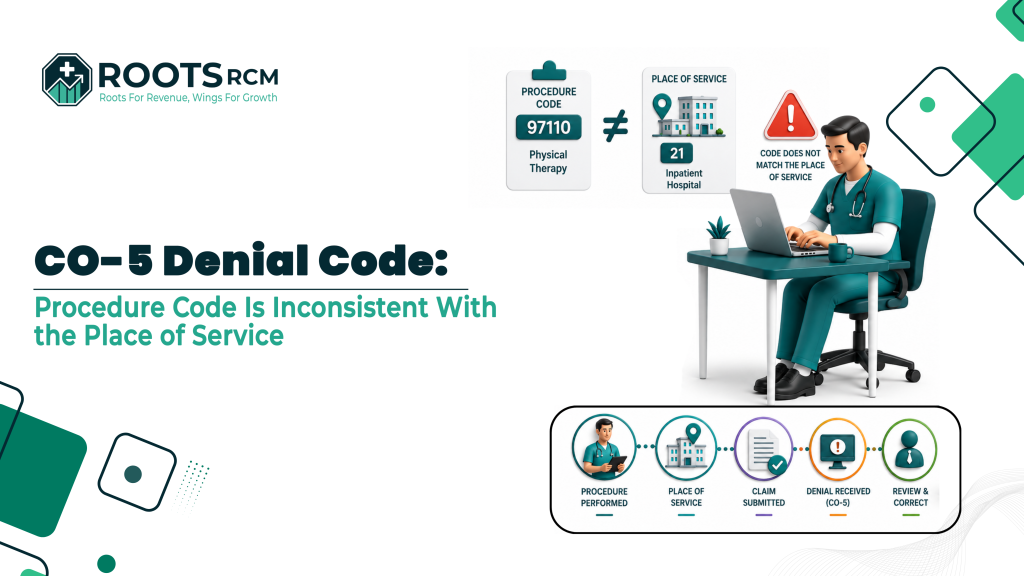
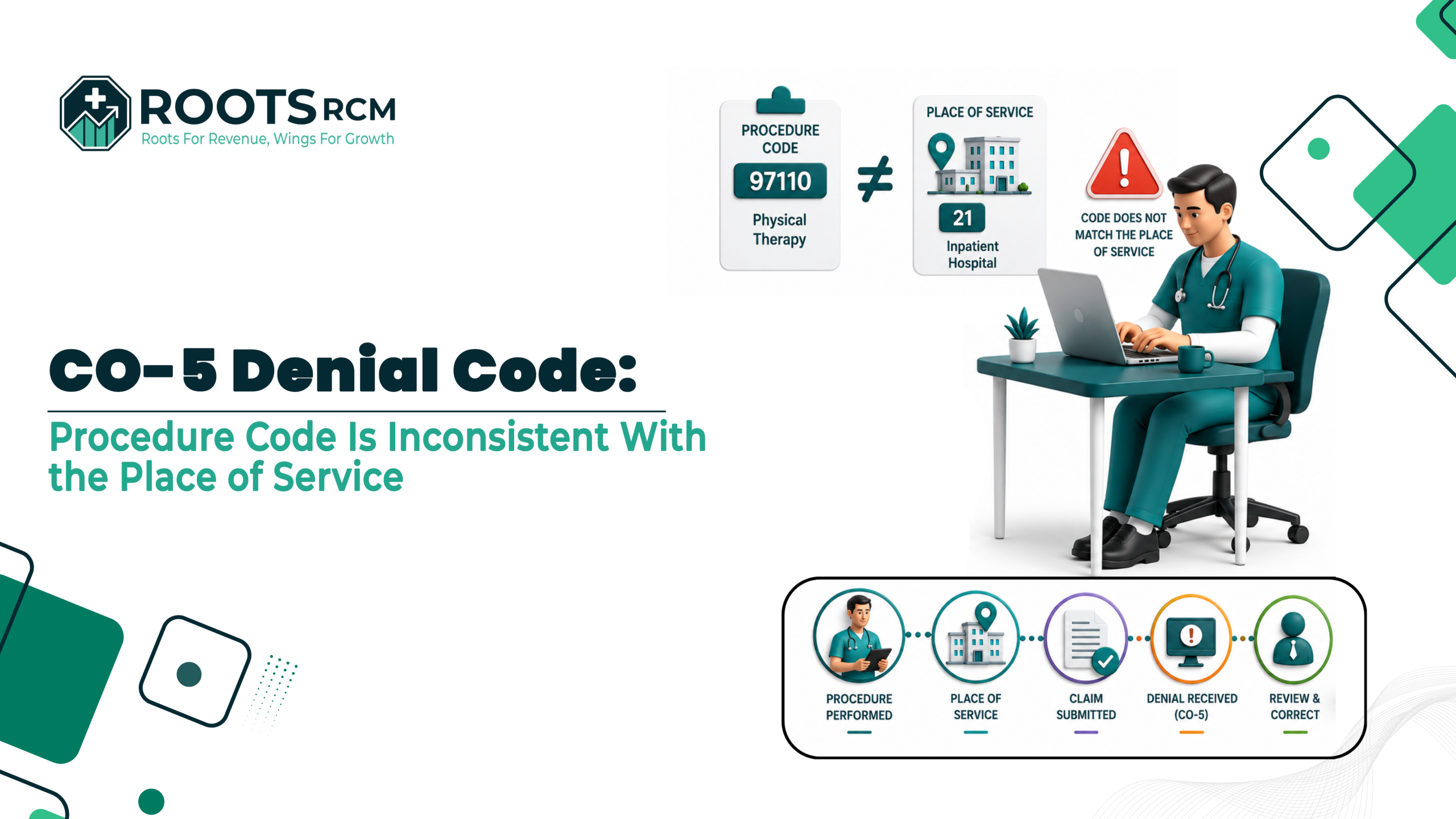
CO-5 Denial means the procedure code is inconsistent with the place of service.
In simple terms, the payer believes that the procedure reported on the claim does not match the location where the service was performed. The Place of Service (POS) code tells the payer where the patient received the service. For example, a service may have been provided in a physician’s office, outpatient hospital, inpatient hospital, ambulatory surgical center, patient’s home, or another setting.
When the procedure code and POS code do not make sense together according to the payer’s rules, the claim may receive a CO-5 Denial. X12 defines CARC 5 as “The procedure code/bill type is inconsistent with the place of service.”
The most common reason for a CO-5 Denial is that the wrong POS code was reported. For example, a provider performs a service in an office but the claim is submitted with a POS representing a hospital setting.
The procedure itself may be completely correct. However, the payer sees a combination of procedure code plus POS code that does not meet its billing rules, resulting in a CO-5 Denial.
A CO-5 Denial can also happen when the wrong procedure code is selected for the setting in which the service was actually provided. Another possibility is that the claim was created correctly in the provider’s system, but the POS was changed incorrectly during claim preparation or submission.
A simple example of a CO-5 Denial: suppose a physician performs a service in the physician’s office. The claim contains the correct procedure code, but the billing team accidentally reports a hospital POS.
The payer receives the claim and sees that the procedure and location do not match its billing rules. The payer may then return the claim with a CO-5 Denial. The physician may have performed the service correctly. The problem is the information reported about where the service took place.
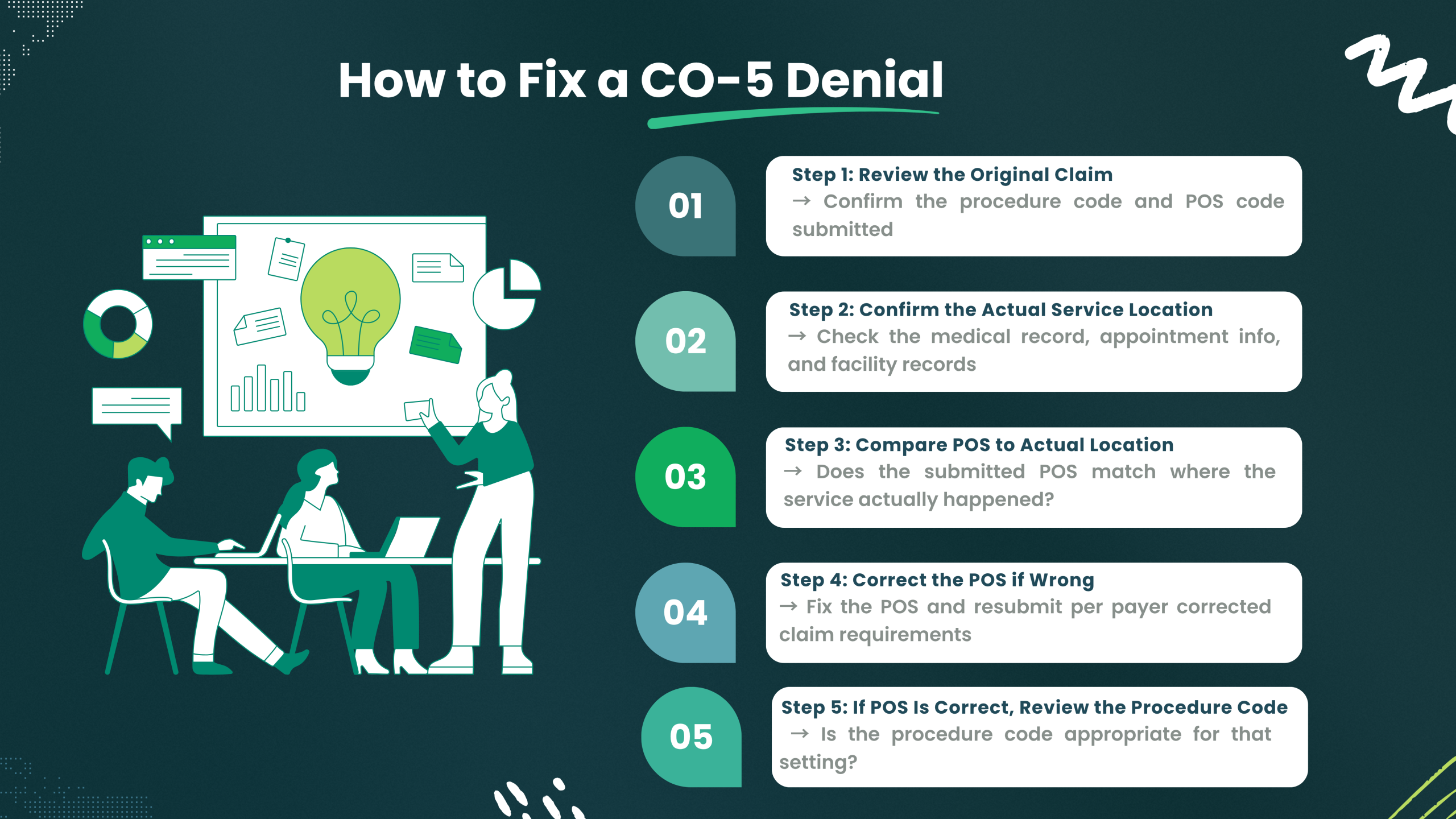
Start by reviewing the original claim.
Do not simply change the POS to another location because that combination is more likely to be paid. Resolving a CO-5 Denial requires the POS to accurately represent where the service was actually provided.
When a CO-5 Denial appears, review:
Procedure code → POS code → Actual location → Documentation → Payer rules
The first question when investigating a CO-5 Denial is simple: Where was the service actually performed?
Once that is confirmed, compare the actual location with the POS submitted on the claim. Then determine whether the procedure code is appropriate for that setting. This approach helps identify whether the CO-5 Denial is a registration and billing error, a coding issue, or a payer specific rule.
POS coding is an important part of professional claim submission because payers use it to understand the setting in which healthcare services were delivered. A CO-5 Denial often points directly to a POS coding issue that should have been caught before submission.
For Medicare professional claims, CMS maintains the official Place of Service Code Set and publishes descriptions for the different POS codes.
The POS should therefore be selected based on the actual setting of the service, not simply on the provider’s usual practice location. For example, a physician who normally works in an office may also provide services in a hospital or another facility. The POS on the claim needs to reflect the location where that particular service was performed. Getting this wrong is one of the most common triggers of a CO-5 Denial.
The best prevention against a CO-5 Denial is to make sure that the service location flows correctly from the practice’s scheduling and billing system into the claim.
Billing teams should also review procedures that are frequently performed in multiple settings. The same provider may perform a service in an office on one date and in a hospital on another, and each claim must reflect the correct location to avoid a CO-5 Denial.
Claim scrubbing systems can also help identify procedure and POS combinations that may require review before submission.
Most importantly, the billing team should not assume that the provider’s usual location is automatically the correct POS for every claim. That assumption is one of the most avoidable causes of a CO-5 Denial.
If the POS was reported incorrectly, the usual solution for a CO-5 Denial is to correct the claim and follow the payer’s resubmission requirements.
If the POS is correct and the payer has issued a CO-5 Denial because it believes the procedure is inconsistent with that setting, the billing team should review the payer’s policy and determine whether additional documentation or an appeal is appropriate.
The correct action always depends on why the CO-5 Denial was assigned in the first place.
A CO-5 Denial means that the payer believes the procedure code or bill type is inconsistent with the reported place of service. The solution is not simply to change the POS.
First determine where the service was actually performed. Then make sure the POS accurately represents that location and that the procedure code is appropriate for the setting.
Accurate procedure coding and accurate place of service coding must work together. When they do not, a CO-5 Denial is the result. And when the same denial keeps appearing in your reports, it is a signal to review the workflow that is allowing the mismatch to reach the payer in the first place.
Disclaimer: This article is provided for general educational and informational purposes only. The examples and information used are fictional or generalized and do not relate to any real patient or patient's medical, insurance, or billing information. Payer policies, requirements, and denial code usage may vary and can change over time. Always verify current payer guidelines and applicable official requirements before taking action on a claim.

CO-5 Denial means the procedure code or bill type is inconsistent with the place of service reported on the claim.
A CO-5 Denial commonly occurs when the wrong POS is reported or when the procedure code does not meet the payer's rules for the reported setting.
Verify where the service was actually performed, review the procedure and POS codes, correct any error, and submit a corrected claim according to payer requirements.
No. The POS must accurately represent the location where the service was provided. Changing it simply to avoid a CO-5 Denial without confirming the actual service location is incorrect.
Yes, a CO-5 Denial is generally a coding consistency issue involving the procedure or bill type and place of service.
Yes. Accurate service location information, correct POS coding, proper claim setup, and pre-submission claim edits can significantly reduce CO-5 Denial occurrences.