
A medical practice can be busy, respected, clinically excellent and financially unhealthy. That may sound contradictory. But it is one of the most important realities of modern healthcare.
A physician can see more patients this year than last year and still experience declining margins. A medical practice can report millions of dollars in charges while collecting substantially less. A clinic can increase revenue while simultaneously becoming less profitable because labor, technology, malpractice coverage, supplies, rent, insurance, and administrative costs rise faster than reimbursement.
This is why Patient Volume is not Profitability, Charges are not Revenue, Revenue is not Cash, and Cash is not necessarily Profit.
The economics of a modern medical practice are considerably more complicated than simply asking, “How many patients did we see?”
In 2026, this challenge has become even more consequential. MGMA reported in June 2026 that 84% of medical groups surveyed had higher year to date operating costs than at the same point in 2025, with respondents reporting an average increase of about 11% among practices whose costs had risen. Labor was the leading pressure, followed by supplies, drugs, insurance, rent, overhead and technology or growth investments.
At the same time, MGMA’s June 30, 2026 poll found only 47% of medical groups reported year to date revenue higher than the same period in 2025, while 36% reported lower revenue.
That gap “costs rising faster or more consistently than revenue” is where financial pressure begins. The modern medical practice therefore needs a different definition of success. The objective is not merely to see more patients. It is to create a sustainable system in which:
Clinical Capacity → Appropriate Utilization → Accurate Documentation → Correct Coding → Contractual Reimbursement → Timely Collection → Controlled Operating Cost → Healthy Margin → Reinvestment in Patient Care. That is the hidden economics of medicine.
Walk into a busy medical practice on a Monday morning. The waiting room is full. The phones are ringing. Physicians are moving rapidly from one examination room to another. Medical assistants are rooming patients. The billing team is submitting claims. The practice owner looks at the schedule and thinks:
“We must be doing well.”
Not necessarily.
A full schedule tells you that demand exists.It does not tell you whether that demand is economically sustainable. The practice could be experiencing:
The practice may therefore be clinically busy but economically weak. That distinction should be at the center of healthcare leadership.
Patient volume is important. Without patients, there is no clinical activity and usually no meaningful revenue. But volume alone can be misleading. Imagine two medical practices each seeing 5,000 visits annually.
Practice A has a favorable payer mix, efficient workflows, strong documentation, low denial rates, appropriate coding, controlled staffing expenses and excellent collection performance.
Practice B has lower paying contracts, excessive administrative labor, poor charge capture, frequent denials, high patient balances and inefficient scheduling.
Same volume.Very different financial outcomes. This leads to a fundamental principle:
“The economic value of a patient encounter is determined by more than the number of encounters”.
It depends on what service was delivered, to whom, under what contract, at what cost, with what documentation, and how successfully the organization ultimately collects the amount it is legitimately entitled to receive.
One of the most common sources of confusion in healthcare management is treating these terms as interchangeable.
They are not.

The amount the practice bills or lists as its charge for a service. A $300 charge does not mean the practice will receive $300.
The amount recognized under the applicable payer arrangement or reimbursement methodology. For Medicare, payment under the Physician Fee Schedule is based on factors including RVUs, geographic practice cost indices and the applicable conversion factor.
The money actually received. Collections can come from:
The economic revenue recognized after appropriate adjustments, contractual allowances and other applicable considerations.
What remains after the costs required to operate the practice are accounted for. This is where the difference between “we billed $10 million” and “we made $1 million” becomes enormous.
A sophisticated healthcare leader therefore never evaluates financial health from charges alone.
One of the biggest leadership mistakes is thinking that revenue cycle begins when the biller submits a claim. It begins much earlier.
Consider a patient scheduled for a procedure. Before the service is performed, the organization may need to establish:
If something fails here, the practice can create a financial problem before the physician has even treated the patient.
This is why frontend operations are not merely administrative. They are financial controls.
The economics of medicine therefore begin at patient access.
Two practices can deliver virtually identical clinical services and have very different financial performance because of payer composition.
Consider:
Each may have different reimbursement levels, contractual requirements, administrative burden and patient responsibility characteristics.
Payer mix therefore affects more than revenue. It affects:
Reimbursement + Administrative workload + Collection Risk + Patient Responsibility + Cash Flow.
A medical practice leader who only monitors total patient volume may miss this entirely.
Suppose Practice A adds 1,000 annual visits but most incremental volume comes from a lower paying contract. Practice B adds only 500 visits but improves its payer mix and contractual reimbursement.
Practice A may report stronger growth. But Practice B may generate better financial performance. The lesson is uncomfortable but important:
“More volume can actually worsen financial performance when the economics of the additional volume are unfavorable”.
Medicare remains an important reference point for physician economics. CMS’s 2026 Physician Fee Schedule established separate conversion factors for qualifying APM participants and non qualifying participants. For 2026, the final conversion factors were $33.57 for qualifying APM participants and $33.40 for non qualifying participants, reflecting statutory and other adjustments.
But a reimbursement update does not automatically mean a practice’s financial position has improved.
Why?
Because reimbursement must be viewed against the cost of delivering care.
MGMA reported in February 2026 that 80% of medical groups surveyed said Medicare reimbursement was below their cost to deliver care.
That is a critical leadership insight. The question is not simply “What does Medicare pay?”
It is:
“What does it cost us to deliver the service, and how does the reimbursement compare with that cost?”
Those are two very different questions.
A medical practice has a complex cost structure.
Some costs are obvious:
Others are easier to overlook:
The financial challenge becomes especially serious when costs grow faster than revenue.
MGMA’s June 2026 data showed that among groups reporting increased operating costs, the average increase was approximately 11%, with labor costs identified as the dominant driver.
This changes the leadership conversation. Cost management is no longer simply about “cutting expenses.”
It becomes a question of:
Which Costs create Capacity, Quality, Revenue or Strategic Advantage and Which Costs simply create Friction?
A struggling medical practice may respond to financial pressure by immediately cutting staff. That may reduce payroll. But what if the eliminated employee was responsible for:
In case of outsourcing you prefer a billing company with lower percentage but it cost you in your collections and more denials.
The organization may save $60,000 in payroll or billing fee but lose $200,000 in collectible revenue.
This is why cost reduction must be based on economic contribution, not simply expense size.
The correct question is not:
“How can we spend less?” It is “How can we spend intelligently?”
Healthcare is labor intensive. A medical practice cannot simply replace every human task with software.
Physicians diagnose and treat. Nurses coordinate care. Medical assistants support clinical workflows. Front office employees facilitate access. Billing professionals manage reimbursement. Managers coordinate the organization.
The financial challenge is therefore to align labor with actual demand.
Suppose a clinic has:
If patient volume fluctuates significantly throughout the week, fixed staffing patterns may create idle capacity at certain times and bottlenecks at others.
The solution may not be fewer employees. It may be better workforce design. That could involve:
In 2026, MGMA reported that medical groups looking for cost reductions most frequently pointed toward automation and outsourcing, with those two approaches accounting for more than half of responses in a January 2026 poll.
This is an important shift from blunt cost cutting toward productivity engineering.
A physician seeing 30 patients per day is not necessarily more productive than one seeing 20. The comparison depends on:
A medical practice should therefore evaluate productivity using appropriate specialty specific measures. Depending on the setting, these may include:
A sophisticated practice does not ask simply:
“How many patients did Dr. X see?” It asks “What clinical and economic value did the capacity generate?”
Consider a physician who could see 25 patients but sees only 18 because of scheduling gaps. Seven appointment opportunities are lost. If those unused slots cannot be recovered, the revenue opportunity disappears permanently.
Healthcare capacity is perishable. An empty appointment slot today cannot be sold tomorrow. This makes:
financial issues, not merely operational ones.
The medical practice that fills capacity intelligently can often improve financial performance without hiring another physician.
A medical practice may perform the service correctly but still fail to collect what it should. The journey is approximately:
Patient → Encounter → Documentation → Coding → Charge Capture → Claim → Adjudication → Payment → Posting → A/R → Final Resolution
At every stage, value can be lost. Consider a simple example.
A service is performed. The documenttion supports appropriate billing. But the charge is never captured. Revenue opportunity $0.
Or the charge is captured but incorrectly coded. The claim is denied. Revenue is delayed.
Or the claim is paid, but the payment is incorrectly posted. Financial reporting becomes distorted.
Or the insurer pays its portion, but patient responsibility remains unresolved for months. Cash flow deteriorates.
This is why revenue cycle is not merely a billing department.It is a financial operating system.
A denial may originate from:
Therefore, a denial report is often a diagnostic report about the entire organization.
A leadership team that merely tells billing staff to “work the denials faster” may be treating the symptom instead of the cause.
A practice can appear profitable on paper and still experience financial stress if cash is not arriving quickly enough.
Consider a medical practice with significant outstanding receivables. The organization may have earned revenue. But if reimbursement is delayed, it still needs cash to pay:
This creates the distinction between profitability and liquidity.
A healthy medical practice therefore monitors not only how much it earns but also ‘How quickly does earned revenue become cash’?
That is where accounts receivable (A/R) becomes a leadership concern.
The patient’s share of healthcare costs can include:
The organization may technically be entitled to collect the balance, but entitlement does not equal cash realization.
Patients may:
This creates a delicate leadership challenge. Aggressive collection strategies can damage patient trust. Weak collection strategies can damage financial sustainability.
The answer is not simply “collect more.”
It is to create a Transparent, Accurate, Compassionate, and Efficient Patient Financial Experience.
A medical practice may purchase:
But purchasing technology does not create value by itself. The real question is:
What measurable problem is this technology solving?
Suppose an AI solution costs $50,000 annually.
If it reduces manual labor by $80,000 and improves collections by $100,000, it may produce significant value.
But if it merely adds another dashboard that merely add value, it may become another operating expense.
Technology must therefore be evaluated through:
Cost → Adoption → Productivity → Quality → Revenue → ROI.
Growth is usually celebrated. But uncontrolled growth can be financially destructive. Imagine a practice expands by opening another location.The organization adds:
But patient volume takes two years to reach sustainable levels. The practice may grow in size while margins decline.
Growth should therefore be evaluated using contribution economics, not prestige. Before expanding, leaders should understand:
Growth is valuable only when it creates sustainable economic value.
A practice may offer multiple services:
They may all appear successful from the top line revenue perspective. But their cost structures may differ substantially.
A service generating $500,000 in revenue might produce less contribution than a service generating $300,000 if the first requires significantly more staffing, supplies, equipment, administrative effort, or space.
This is why leaders should understand service line contribution margin. Revenue alone cannot tell the full story.
Payer contracts can quietly determine the economics of an entire medical practice. A contract affects:
A practice may work extremely hard to increase volume while failing to examine whether its payer contracts adequately compensate it for the cost of delivering care.
Contracting should therefore be treated as a strategic discipline. Before accepting or renewing a contract, leaders should understand:
What does this payer actually contribute to the organization's financial sustainability?
‘Fee for Service’ historically emphasizes activity. More services generally produce more billable activity.
‘Value Based Care’ introduces a different economic model. Now organizations may be evaluated on:
A practice may therefore need to manage both
Revenue from individual encounters
and
Economic performance across a patient population.
That requires stronger data infrastructure and leadership. The practice of the future cannot operate purely from a claims perspective. It must understand both clinical performance and financial performance.
A sophisticated dashboard should not contain 100 disconnected metrics. Leadership needs a focused set of indicators that explain what is actually happening.
The important principle is not merely measuring these numbers. It is connecting them.
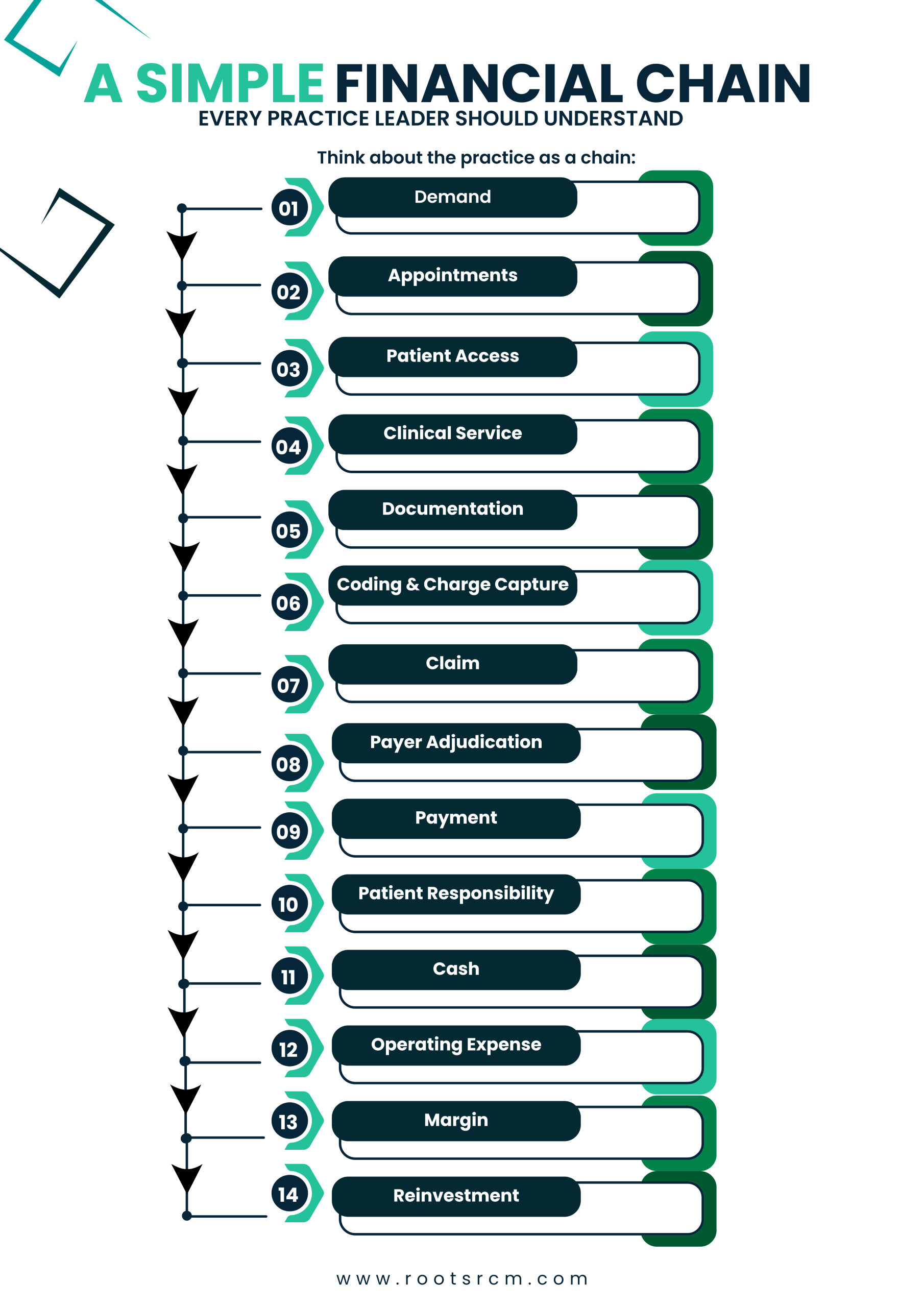
A weakness anywhere in this chain can affect the final outcome.This is why financial leadership in healthcare cannot be confined to the CFO, administrator, or billing manager. The economics are distributed throughout the organization.
Profitability should not mean “We collected more money this month.”
A more meaningful definition is
“The organization consistently generates sufficient economic value from its clinical activity to cover the true cost of delivering care, sustain its workforce, invest in quality and innovation, withstand financial shocks, and continue serving patients”.
That definition includes resilience. A practice that generates a strong margin for three months but cannot retain physicians, replace equipment, withstand payer changes, or invest in cybersecurity is not necessarily financially healthy.
The first step is to stop managing the practice from a single number.
Do not manage solely by
Instead, build a connected economic picture.
Know what it costs to deliver the service and what it actually contributes.
Know which contracts support the practice and which create financial or administrative pressure.
Strengthen registration, eligibility, authorization, documentation, coding, claim submission, payment posting and A/R management.
An unused appointment slot represents more than an empty chair, it represents unused clinical capacity.
Measure productivity and workflow before reducing headcount.
Every significant technology investment should have a defined business case and measurable outcomes.
Physicians and operational leaders should understand the financial consequences of the workflows they control.
One of the most dangerous management behaviors is Local Optimization. Suppose the billing department reduces staff to cut expenses.
Its labor expense decreases.
The organization saves money in one department while losing substantially more elsewhere.
Or the practice increases physician schedules to maximize utilization. Revenue rises. But appointment times become compressed, staff burnout increases, documentation quality declines, and patient satisfaction falls.
Again, one metric improves while the system deteriorates. Healthcare leadership requires System Optimization.
The objective is not to make each department look efficient.It is to make the organization perform better as a whole.
The current environment makes this especially important.
MGMA’s 2026 data shows a difficult combination: 84% of surveyed groups reported higher operating costs, while only 47% reported higher year to date revenue.
Meanwhile, MGMA reported that 80% of surveyed groups considered Medicare reimbursement below the cost of delivering care.
And the regulatory environment remains a significant operational burden, with MGMA’s 2026 Regulatory Burden Report identifying prior authorization, Medicare Advantage requirements and quality reporting among major issues diverting practice resources away from patient care.
These conditions make financial discipline increasingly important. But the answer is not simply to cut. It is to improve the economics of the entire care-delivery system.
The next generation of healthcare leaders will increasingly ask questions such as:
This represents a significant evolution in practice management. The objective becomes:
Maximize sustainable clinical value, not simply maximize activity.
Imagine a specialty practice with 10 providers.
Its annual collections increase by 8%. Leadership celebrates. But underneath the headline:
The practice grew revenue. But its financial position deteriorated.
Now imagine leadership looking at the same practice differently.
Revenue might not explode.But the margin improves and that is the point.
Financial leadership is not always about making more money. Sometimes it is about preventing money already earned from DISAPPEARING.
A successful practice is not necessarily the largest practice. It is not necessarily the busiest. It is not necessarily the one with the highest charges. And it is not necessarily the organization that reports the fastest revenue growth.
A genuinely successful practice can:
That is a much higher standard.
A medical practice exists first to care for patients. But caring for patients requires resources.
Someone must employ the clinicians. Someone must maintain the facility. Someone must purchase equipment. Someone must maintain cybersecurity. Someone must operate the EHR. Someone must manage compliance. Someone must process claims. Someone must collect legitimate reimbursement. Someone must pay the workforce.
That is why the economics of healthcare cannot be separated from the mission of healthcare.The challenge for today’s healthcare leader is not to turn medicine into a business. It is to build a financially intelligent organization capable of sustaining excellent medicine.
The practice of the future will not ask only:
How many patients did we see?
It will ask:
That is the deeper economics of modern medicine.
Because the ultimate financial objective of a healthcare organization is not simply to generate revenue. It is to create enough sustainable economic strength to keep delivering Excellent Care.

Because volume does not account for reimbursement, payer mix, staffing expense, overhead, denials, patient collections, service line costs or other operating expenses. A practice can increase visits while its cost per encounter rises faster than its collectible revenue.
Revenue represents the economic income generated from healthcare services and other activities. Profit is what remains after the costs of operating the organization are accounted for. A practice can have high revenue but low or negative operating margins.
No. Additional volume is beneficial only when the incremental revenue exceeds the incremental cost and does not undermine quality, access, staff capacity or patient experience. Low paying or administratively expensive volume can sometimes worsen financial performance.
Different payers can have different reimbursement levels, contractual requirements, patient responsibility patterns and administrative burdens. Consequently, two practices with identical clinical volume can have substantially different financial results because their payer mixes differ.
Medicare is a major payer for many physician practices, and its Physician Fee Schedule establishes reimbursement using a methodology involving RVUs, geographic adjustments and conversion factors. Changes in Medicare payment can therefore influence practice revenue, staffing, access and strategic planning.
Not necessarily. Collection performance is important, but it must be interpreted alongside payer mix, operating costs, contractual allowances, service mix, A/R, provider productivity and overall margin.
One major mistake is managing individual departments or metrics in isolation. A practice may reduce one expense while creating a larger revenue loss elsewhere. Sustainable performance requires understanding the entire clinical and financial workflow.
RCM can protect revenue through accurate registration, eligibility verification, authorization management, documentation and coding support, clean claim submission, denial prevention, payment accuracy, underpayment identification, patient-responsibility management and disciplined A/R follow-up.
Not automatically. Leadership should first determine what each role contributes to patient access, clinical capacity, compliance, revenue capture and operational efficiency. Eliminating a revenue-protecting function can cost more than its salary.
Start with the problem rather than the technology. Define the current cost or inefficiency, establish measurable objectives, calculate expected ROI, assess implementation and integration requirements, monitor adoption, and compare actual outcomes against the business case.
The appropriate dashboard varies by specialty and organization, but commonly includes net collections, A/R aging, days in A/R, denial rate, payer mix, revenue per provider, provider productivity, labor expense, operating margin, cost per encounter and service line contribution margin.
They are increasingly interconnected. Poor clinical processes can create unnecessary utilization, complications and costs, while strong quality and care coordination can improve outcomes and support value based reimbursement. Financial performance should therefore not be pursued independently of clinical quality.
Financial sustainability means the organization can consistently generate enough economic value to cover the cost of delivering care, retain its workforce, maintain operations, invest in quality and technology, withstand reimbursement or economic shocks, and continue serving its patient population.