
For generations, the success of a physician was measured primarily by clinical expertise, the ability to diagnose accurately, treat effectively, and improve patient outcomes. While clinical excellence remains the foundation of healthcare, the modern healthcare environment demands much more. Today’s providers operate within one of the most complex and heavily regulated industries in the world, where financial sustainability, operational efficiency, regulatory compliance, technology adoption, patient experience, and strategic leadership are as critical to success as clinical competency.
Medical schools produce exceptional clinicians, but they rarely prepare physicians to lead businesses. As a result, many providers enter practice with limited exposure to healthcare finance, reimbursement systems, operational management, human resources, marketing, technology, or strategic planning. This knowledge gap has become increasingly consequential as shrinking reimbursements, rising operating costs, workforce shortages, and evolving payment models reshape the economics of healthcare.
This article explores why clinical excellence alone is no longer sufficient to build a successful healthcare organization. It examines the intersection of medicine and business, the leadership capabilities required in today’s healthcare landscape, and the strategic decisions that distinguish resilient organizations from those that struggle despite delivering outstanding patient care.
Medicine has traditionally been regarded as a profession grounded in ethics, science, and service. Physicians have long been trained to prioritize patient welfare, clinical judgment, and evidence based care. Historically, administrative responsibilities were relatively modest, reimbursement structures were simpler, and independent practices enjoyed greater autonomy.
Over the past three decades, however, healthcare has undergone profound transformation. The transition from ‘fee for service to ‘value based’ reimbursement. The expansion of federal regulations, the growth of commercial insurance, widespread adoption of electronic health records, increasing administrative requirements, and rapid technological advancement have fundamentally altered the way healthcare is delivered and financed.
Today, every patient encounter represents not only a clinical interaction but also a financial transaction, a compliance obligation, a documentation requirement, a data collection event, and a quality reporting opportunity. Decisions made in the examination room influence reimbursement, risk adjustment, quality scores, contractual performance, and long term organizational sustainability.
Healthcare has evolved into one of the world’s most sophisticated business ecosystems, requiring leaders who can navigate both medicine and management.
Physicians spend years mastering anatomy, physiology, pathology, pharmacology, diagnostics, and clinical decision making. Residency and fellowship further refine these competencies through intensive practical experience.
Yet formal education in business management remains remarkably limited.
Many physicians complete more than a decade of medical education without meaningful instruction in:
This gap is not a reflection of educational shortcomings but of historical priorities. Medical education was designed to prepare physicians to care for patients, not to manage complex healthcare enterprises.
The consequence is that many clinicians find themselves leading organizations without the business framework necessary to navigate today’s healthcare environment.
A physician orders a diagnostic imaging study because it is clinically appropriate. However, whether that service is reimbursed may depend on prior authorization, documentation of medical necessity, payer specific coverage policies, and contractual requirements. A provider delivers excellent care but documents the encounter incompletely. The claim is denied, reimbursement is delayed, and the organization incurs additional administrative costs. Not because of poor medicine, but because of inadequate documentation. A practice hires additional staff to reduce patient wait times. While patient satisfaction improves, payroll expenses rise faster than revenue because scheduling inefficiencies reduce provider productivity. These examples illustrate a broader truth that ‘clinical excellence and business performance are deeply interconnected’. Healthcare leaders must understand how operational, financial, and administrative decisions influence the organization's ability to sustain high quality patient care.
Unlike most industries, healthcare organizations rarely determine the price of their own services. Payment is largely dictated by Medicare, Medicaid, and commercial insurance contracts. Each with distinct reimbursement methodologies, documentation requirements, quality metrics, and compliance obligations.
At the same time, operating expenses continue to increase due to inflation, workforce shortages, cybersecurity investments, technology adoption, regulatory compliance, and rising supply costs.
This creates a challenging economic equation:
As a result, financial sustainability depends less on increasing prices and more on improving operational efficiency, reducing waste, optimizing revenue capture, and delivering measurable value.
Clinical excellence remains essential, but long term success now rests on six interconnected pillars.
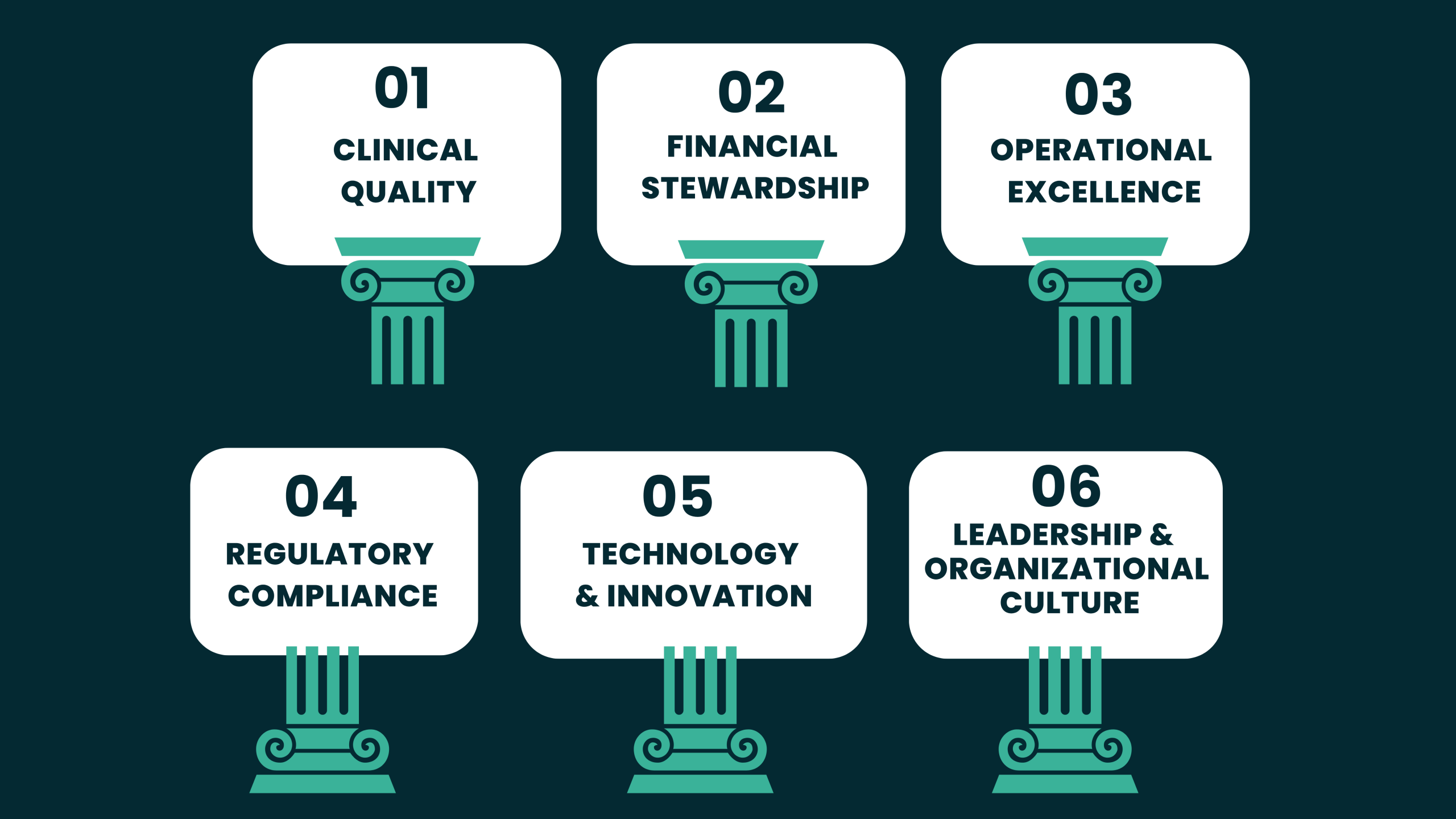
High quality patient care remains the organization’s core purpose. Strong outcomes, patient safety, and evidence based medicine build trust and support valuebased reimbursement.
High quality patient care remains the organization’s core purpose. Strong outcomes, patient safety, and evidence based medicine build trust and support valuebased reimbursement.
Efficient workflows reduce delays, improve patient access, minimize administrative burden, and enhance staff productivity. Operational excellence transforms limited resources into sustainable performance.
Healthcare operates within an extensive regulatory framework. Compliance with CMS requirements, HIPAA, payer policies, and quality reporting protects organizations from financial penalties and reputational harm.
Electronic health records, telehealth, artificial intelligence, automation, and data analytics are no longer optional enhancements. They are strategic tools that improve efficiency, decision making, and patient engagement.
Strong leadership aligns teams around a shared mission, fosters accountability, supports professional development, and creates environments where clinicians and staff can thrive.
Weakness in any one pillar ultimately affects the others.
Many healthcare organizations struggle not because they provide poor care, but because they underestimate the importance of business fundamentals.
Common consequences include:
These challenges often develop gradually, making them difficult to recognize until financial pressures become significant.
Imagine two independent internal medicine practices serving similar communities.
Both employ experienced physicians, maintain strong clinical outcomes, and care for comparable patient populations.
Practice A focuses almost exclusively on clinical operations. Financial reporting is not reviewed frequently, payer contracts renew automatically, and operational improvements are largely reactive.
Practice B embraces a broader leadership approach. Physicians meet monthly with administrative leaders to review key performance indicators, analyze reimbursement trends, monitor patient satisfaction, and identify workflow improvements. Investments are made in staff training, technology, and strategic planning.
Five years later, Practice B has expanded its services, recruited additional clinicians, and maintained financial stability despite industry pressures. Practice A continues to deliver excellent care but struggles with declining margins, staffing shortages, and delayed investments.
The difference is not medical expertise. It is leadership.
Some clinicians worry that emphasizing business principles may compromise patient care. In reality, effective management strengthens the organization’s ability to fulfill its clinical mission.
A financially stable practice can invest in advanced equipment, retain skilled staff, reduce appointment wait times, expand access to underserved populations, and adopt innovative technologies that improve outcomes.
Sound business practices do not compete with compassionate care they enable it.
The healthcare industry increasingly recognizes the need for physicians who can bridge clinical expertise with executive leadership. Many clinicians are pursuing additional education in healthcare administration, business management, public health, or informatics to prepare for leadership roles.
Healthcare organizations can also cultivate leadership by providing mentorship, interdisciplinary collaboration, financial literacy training, and opportunities for physicians to participate in strategic decision making.
Leadership is not confined to executive offices. It is developed through continuous learning and intentional practice.
The physician of the future will continue to be a healer, educator, and advocate. But increasingly, they will also be a strategist, innovator, communicator, and organizational leader.
Moderen Tech will streamline administrative tasks, value based care will reward measurable outcomes, and patients will expect seamless experiences. Success in this environment will require leaders who understand both the science of medicine and the mechanics of modern healthcare organizations.
The most successful practices will not necessarily be those with the highest patient volumes. They will be those that combine clinical excellence with operational discipline, financial insight, technological agility, and visionary leadership.
Medicine will always be a profession defined by compassion, science, and a commitment to improving lives. Yet the ability to deliver exceptional care depends on the strength of the organizations that support it.
Clinicians cannot fulfill their mission if their practices are financially unstable, operationally inefficient, or overwhelmed by administrative complexity. Likewise, healthcare organizations cannot achieve lasting success by focusing solely on financial performance while neglecting the quality of care they provide.
The future belongs to healthcare leaders who recognize that medicine and business are not opposing forces but complementary disciplines. Clinical excellence earns a patient’s trust, business excellence ensures that trust can be sustained for years to come.
In today’s healthcare landscape, the question is no longer whether physicians should understand the business of medicine. The question is whether healthcare organizations can afford leaders who do not.