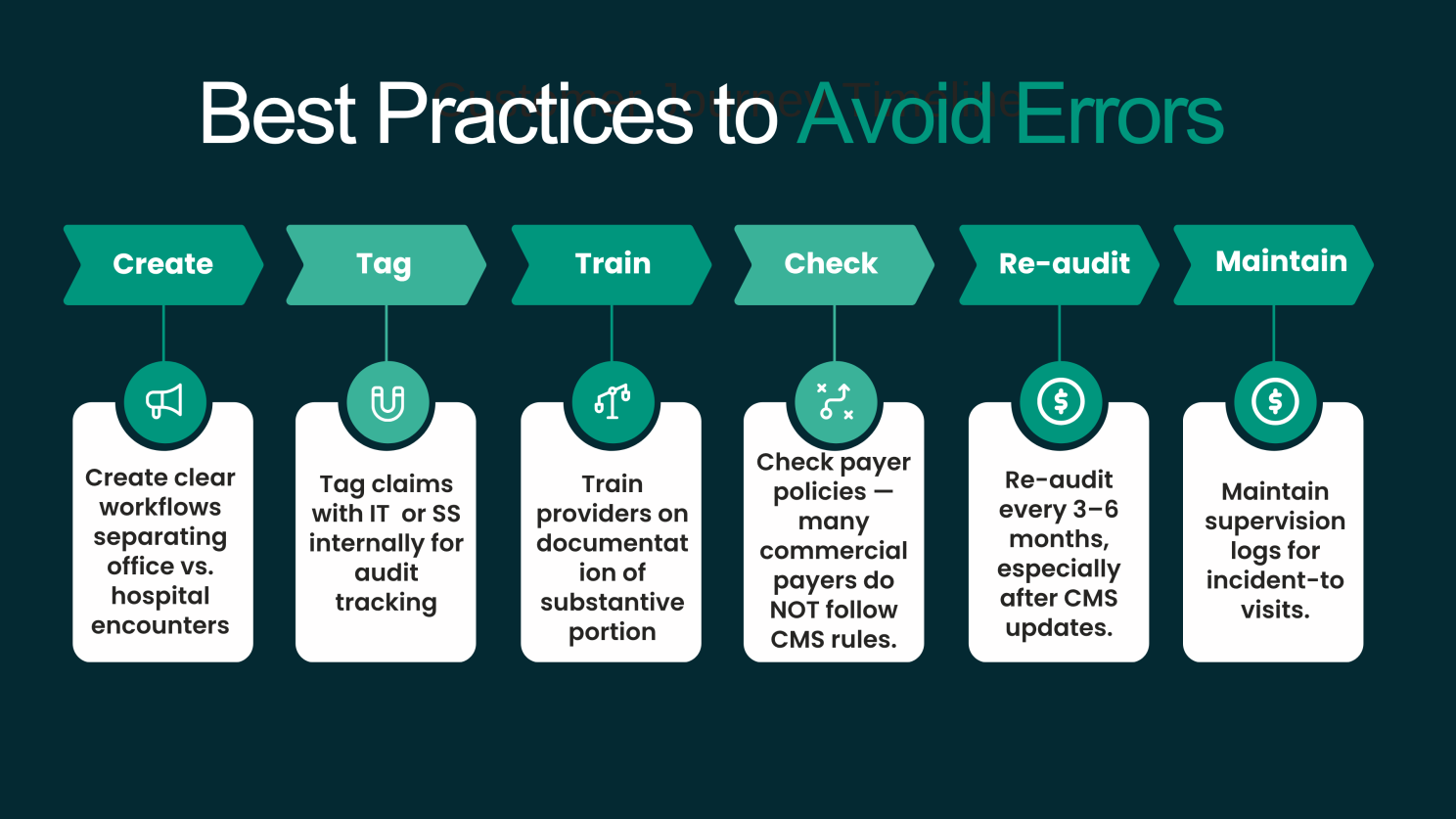
Incident-to billing is only applicable in physician office settings and requires an established plan of care by the physician, who must remain involved and in direct supervision in the office suite. For anything to qualify for RCM compliance, the service must be a follow-up to a previously identified problem. Split/Shared services are limited to hospital and facility-type encounters in which the physician and NPP both participate. Under the
“substantive portion” rule, whoever performs the majority of the key components of a visit is considered to be providing that service.
Incident-To is meant to protect the continuity of the physician-guided plan, while Split/Shared was created to recognize collaborative hospital care. Moreover, Incident-To always bills under the physician for 100%, whereas Split/Shared can be billed under either provider, depending on documentation. Supervisory rules are also different: Incident-To requires direct supervision, while Split/Shared does not require direct supervision for services. These distinctions should be clearly defined in internal billing protocols for every RCM team.