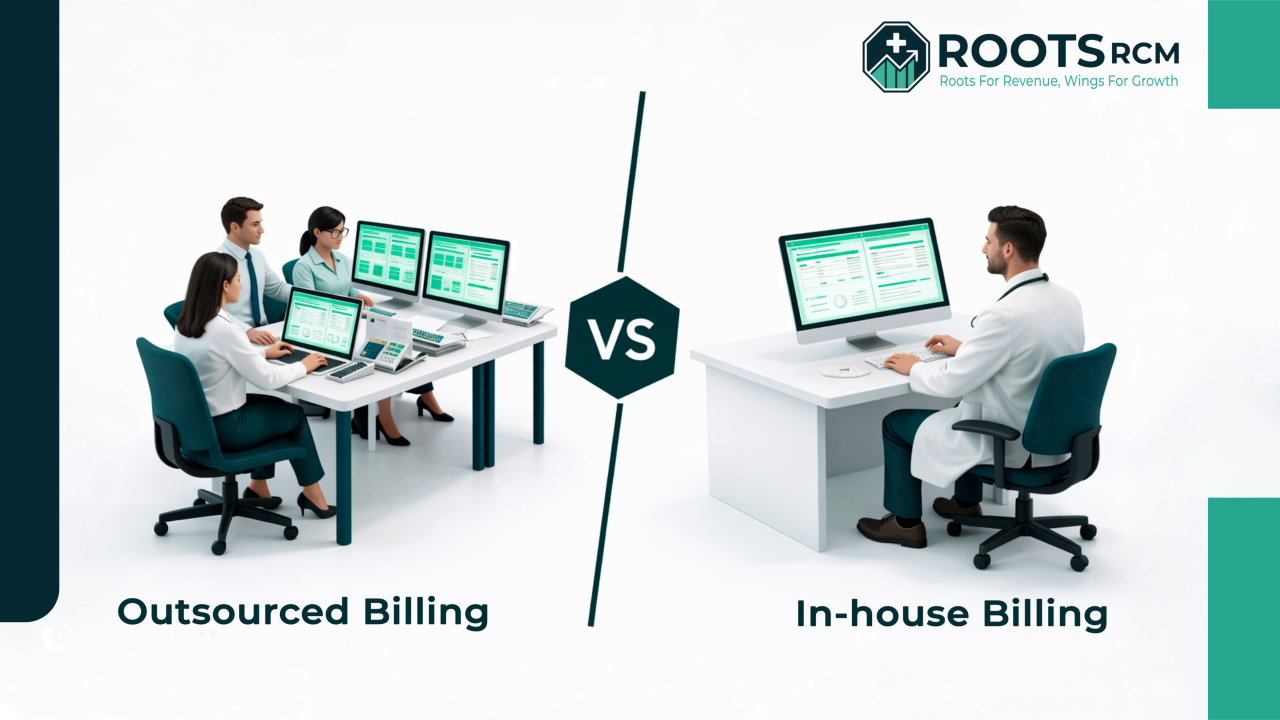
Medical billing most often applies to healthcare practices (e.g., clinics, hospitals, or medical groups), where it involves complex coding, insurance claims, compliance (like HIPAA and CMS rules), and revenue cycle management (RCM). That complexity is why medical billing outsourcing has become one of the most talked about methods for practices today.
For general businesses (e.g., invoicing clients outside healthcare), billing works on the same basic principles, but with far fewer regulations and less complexity, so outsourcing is driven more by cost and scalability than by coding or denial expertise.
Here’s a balanced comparison based on key factors like cost, control, efficiency, and performance.
Key Comparison
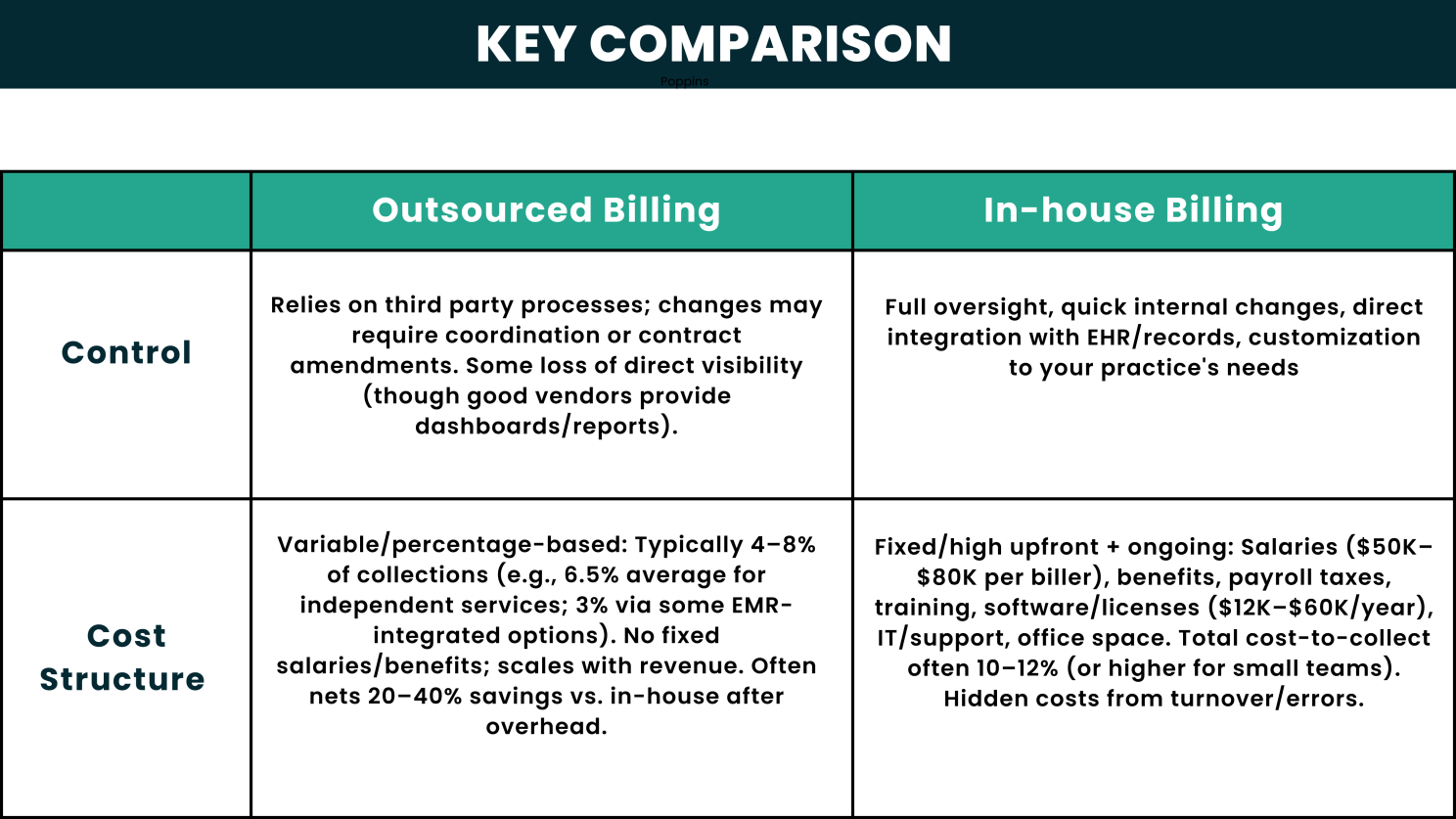
1. Control
In-house: Full oversight, fast internal changes, direct integration with EHR/records, customization to your practice’s needs.
Outsource: Relies on third-party processes; changes may require coordination or contract amendments. Some loss of direct visibility, though good vendors provide dashboards and reports. This is one of the main trade-offs practices weigh before committing to medical billing outsourcing.
2. Cost Structure
In-house: Fixed/high upfront + ongoing: Salaries ($50K – $80K per biller), benefits, payroll taxes, training, software/licenses ($12K – $60K/year), IT/support, office space. Total cost-to-collect often 10 -12% (or higher for small teams). Hidden costs from turnover/errors.
Outsource: Variable/percentage based: Typically 4-8% of collections (e.g., 6.5% average for independent services; 3% via some EMR integrated options). No fixed salaries or benefits; scales with revenue. Often nets 20-40% savings vs. in-house after overhead. This is where medical billing outsourcing tends to win on raw numbers alone.
Key Comparison: Medical Billing Outsourcing Vs. In-House Billing
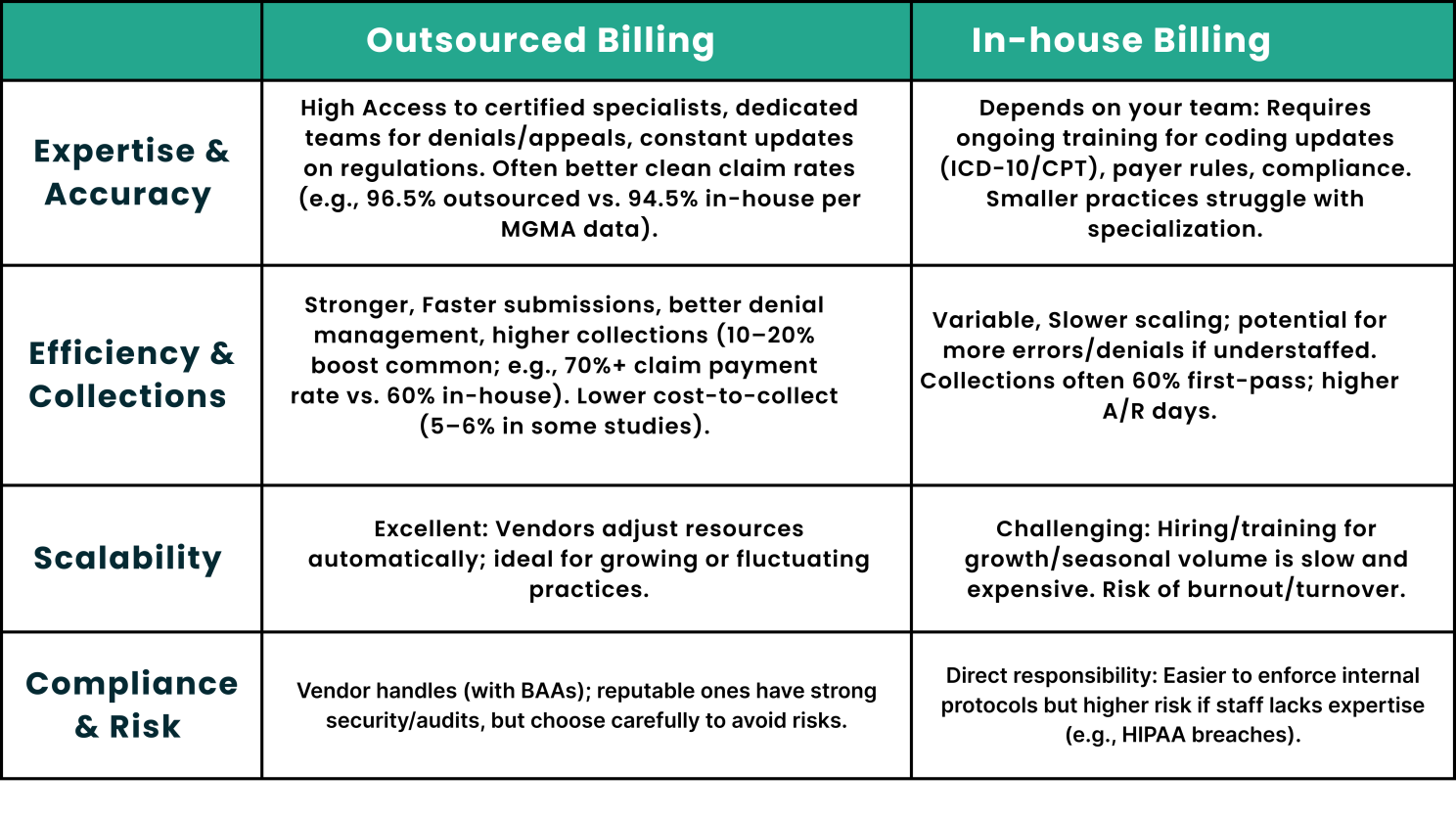
3. Expertise & Accuracy
Inhouse: Depends on your team: Requires ongoing training for coding updates (ICD-10/CPT), payer rules, compliance. Smaller practices struggle with specialization.
Outsource: High Access to certified specialists, dedicated teams for denials/appeals, constant updates on regulations. Often better clean claim rates (e.g., 96.5% outsourced vs. 94.5% in-house per MGMA data). This access is a key reason medical billing outsourcing appeals to smaller practices.
4. Efficiency & Collections
In-house: Variable, slower scaling; potential for more errors and denials if understaffed. Collections often 60% first-pass; higher A/R days.
Outsource: Stronger, Faster submissions, better denial management, higher collections (10–20% boost common; e.g., 70%+ claim payment rate vs. 60% in-house). Lower cost-to-collect (5–6% in some studies).
5. Scalability
In-house: Challenging: Hiring/training for growth/seasonal volume is slow and expensive. Risk of burnout/turnover.
Outsource: Excellent: Vendors automatically adjust resources; ideal for practices that are growing or fluctuating. This flexibility is why medical billing outsourcing scales better with seasonal volume.
6. Compliance & Risk
In-house: Direct responsibility: Easier to enforce internal protocols but higher risk if staff lacks expertise (e.g., HIPAA breaches).
Outsource: Vendor handles (with BAAs); reputable ones have strong security/audits, but choose carefully to avoid risks.
Key Comparison: Medical Billing Outsourcing Vs. In-House Billing
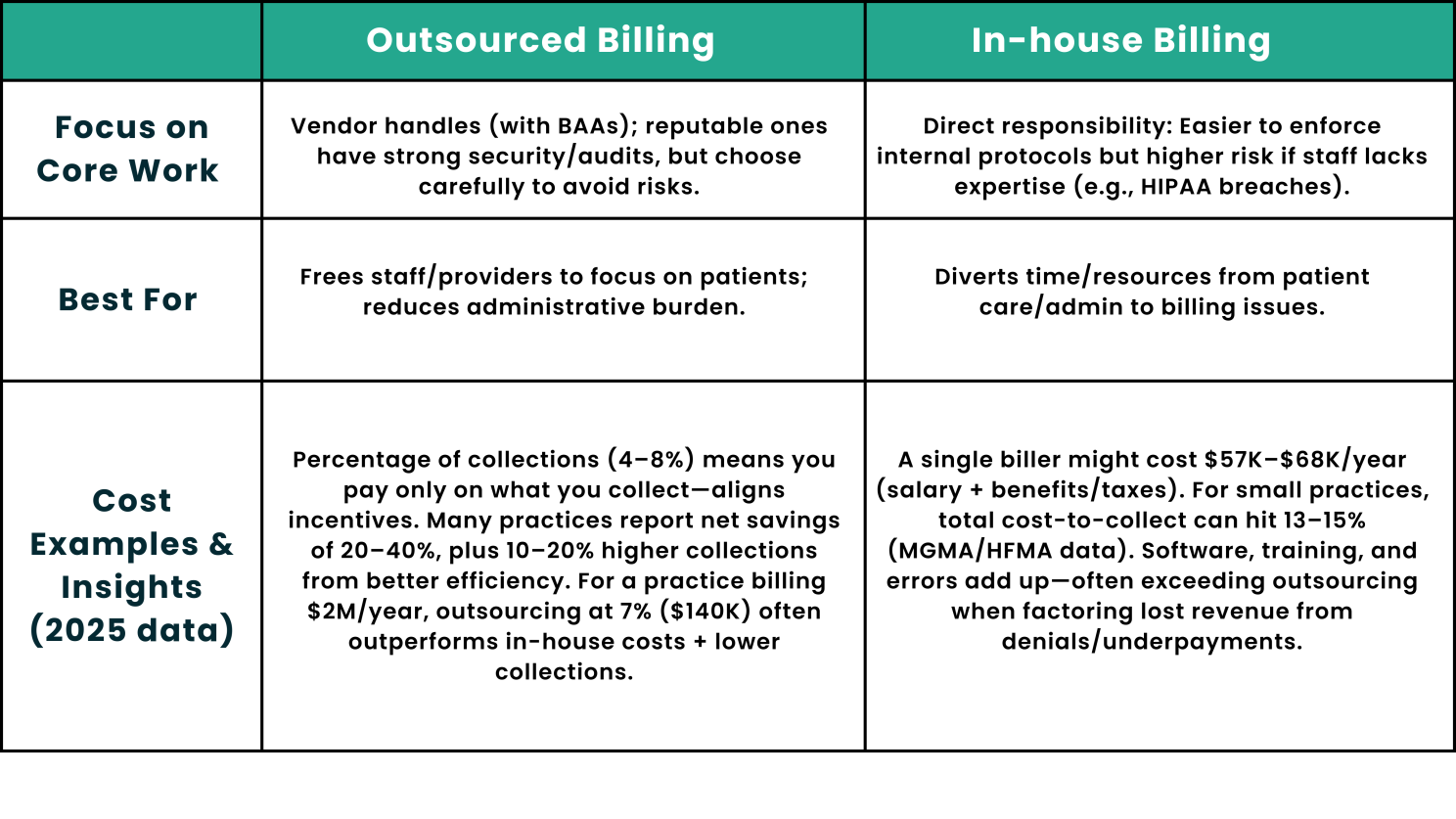
7. Focus on Core Work
In-house: Diverts time/resources from patient care/admin to billing issues.
Outsource: Frees staff/providers to focus on patients; reduces administrative burden.
This is often considered as one of the most underrated benefits of medical billing outsourcing.
8. Best For
In-house: Larger practices with established teams, unique needs, or strong preference for control. Small/simple billing where costs stay low.
Outsource: Small to mid sized practices, those with high complexity/denials, staffing challenges, or wanting to maximize revenue without overhead, and for growing practices.
9. Cost Examples & Insights (2025 data)
In-house: A single biller might cost $57K–$68K/year (salary + benefits/taxes). For small practices, total cost to collect can hit 13–15% (MGMA/HFMA data). Software, training, and errors add up, often exceeding outsourcing when factoring in lost revenue from denials/underpayments.
Outsourced: A percentage of collections (4–8%) means you pay only on what you collect, aligning incentives . Many practices report net savings of 20-40%, plus 10-20% higher collections from better efficiency. For a practice billing $2M/year, medical billing outsourcing at 7% ($140K) often outperforms in-house costs and results in lower collections. Trends show outsourcing growing due to rising complexities (e.g., payer changes, AI tools in vendors), with many practices saving $150K+ annually while boosting revenue.
Key Comparison: Medical Billing Outsourcing Vs. In-House Billing
Bottom Line Recommendation
Medical billing outsourcing is often the better choice for most healthcare practices, especially small and mid-sized ones, because it lowers net costs, improves collections, provides access to expertise, and supports scalability. It shifts fixed costs to variable and lets you focus on patients rather than regulations and staffing headaches.
In-house makes sense if you already have a strong, experienced team, prefer maximum control, or have very simple billing and low volume where overhead stays minimal.
Evaluate your practice's specifics:
Calculate your current cost to collect (total RCM expenses ÷ collections), denial rates, and A/R days.
RootsRCM provides free audits and ROI calculators to compare directly, as well as customized services tailored to practice requirements at the most affordable rates.