Medical claim denials are no longer a “billing department problem.”
In 2026, medical claim denials represent a systemic operational failure spanning registration, clinical documentation, coding, payer intelligence, and governance. With denial rates averaging 11–15% and over 41% of providers exceeding a 10% denial rate, the industry has crossed a critical threshold where reactive denial management is no longer sustainable.
According to Experian Health’s State of Claims 2026 report, the most revealing trend is not just what is being denied, but where denials originate. Over half of all medical claim denials are triggered before a claim ever reaches a payer’s adjudication engine.
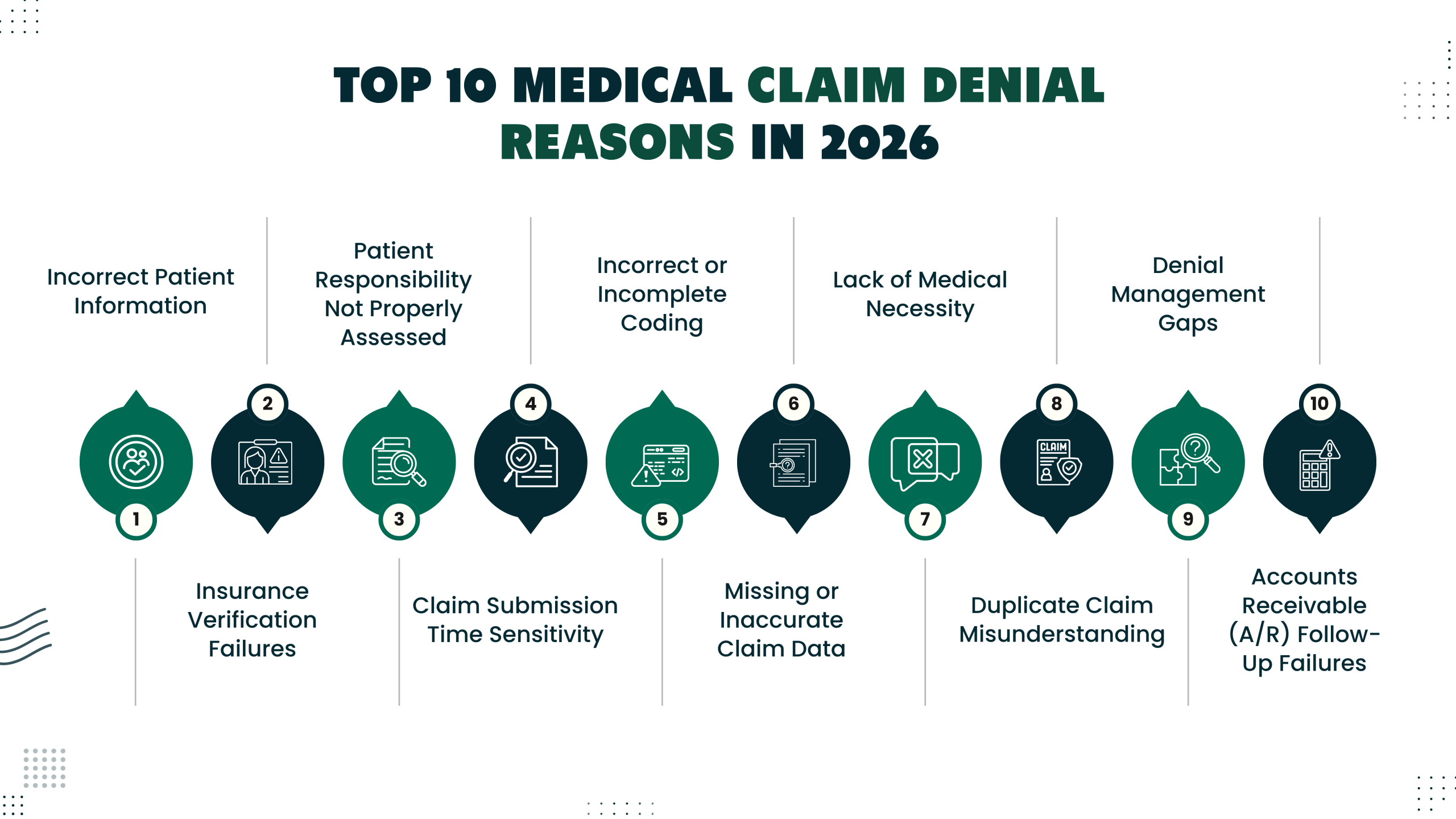
This blog breaks down the top 10 denial drivers in 2026, but more importantly, it explains why they persist, how they interconnect, and what truly differentiates organizations that control medical claim denials from those that constantly chase them.
Top 10 Medical Claim Denial Reasons in 2026
1. Incorrect Patient Information
The First Crack in the Revenue Cycle
Incorrect patient demographics remain one of the most underestimated medical claim denial triggers. Simple errors, misspelled names, wrong date of birth, outdated addresses, or incorrect subscriber details can cause claims to reject before they are even reviewed.
In 2026, payer systems cross-check patient data against multiple databases in real time. Even a minor mismatch can result in an instant rejection rather than a correctable denial.
Why this persists:
Patient self-registration portals, rushed front desks, and lack of re-verification at follow-up visits allow errors to propagate across systems.
Impact:
Claims never enter adjudication, leading to rework, delayed cash, and increased administrative cost.
2. Insurance Verification Failures
Eligibility Is Not the Same as Coverage
Many practices verify that insurance exists, but fail to verify what the plan actually allows.
Insurance verification errors include:
Inactive or terminated coverage
Incorrect plan selection
Missed pre-authorization requirements
Overlooked benefit limitations
Key 2026 reality:
Eligibility responses often show active coverage but hide critical constraints such as visit limits, service exclusions, or network restrictions.
Impact:
Medical claim denials occur after services are rendered, shifting financial responsibility to the practice or the patient.
3. Patient Responsibility Not Properly Assessed
The Growing Financial Blind Spot
With high-deductible health plans now dominant, patient responsibility errors are a major contributor to medical claim denials and bad debt.
Common misses include:
Unmet deductibles
Incorrect copay or coinsurance
Failure to collect balances upfront
Misunderstanding secondary coverage
Why this matters:
When patient responsibility is miscalculated, claims may pay partially or deny, and patient collections become harder after the fact.
2026 trend:
Patient responsibility now represents 22–35% of total revenue in many specialties.
4. Incorrect or Incomplete Coding
Where Technical Accuracy Meets Clinical Reality
Coding errors continue to drive a large share of medical claim denials. Incorrect CPT codes, ICD-10 mismatches, missing modifiers, or lack of medical necessity linkage.
What has changed in 2026 is payer sophistication
AI models analyze coding patterns Claims are compared against specialty benchmarks Documentation is evaluated for clinical intent, not just presence.
Common problem:
Codes may be technically valid but unsupported by documentation, triggering denials or audits.
5. Claim Submission Time Sensitivity
When Timing Alone Kills Revenue
Timely filing denials are among the most painful because they are often non-appealable .
Each payer has its own submission window ranging from 30 to 365 days and missing it by even one day can mean total revenue loss.
Root causes include
Delayed charge entry
Incomplete documentation
Poor internal handoffs
Ineffective follow-up workflows
Key insight:
They reflect breakdowns in operational discipline and are a leading cause of preventable medical claim denials.
6. Missing or Inaccurate Claim Data
The No.1 Medical Claim Denial Driver in 2026
According to 2026 industry reports, missing or inaccurate claim data is the single largest contributor to denials.
Payers use automated edits that reject claims instantly, leaving no room for manual review.
Cost:
Each preventable medical claim denial costs over $100 in rework, excluding delayed reimbursement.
7. Lack of Medical Necessity
The Hardest Denial to Reverse
Medical necessity denials occur when documentation does not sufficiently justify the service provided.
In 2026
Payers rely heavily on algorithmic reviews
High-cost services face aggressive scrutiny
Appeals without strong documentation have low success rates
Key failure point:
Generic diagnoses and templated notes that don’t tell the clinical story remain one of the top reasons medical claim denials go unresolved.
8. Duplicate Claim Misunderstanding
Automation’s Hidden Side Effect
Duplicate medical claim denials often occur unintentionally due to:
System resubmissions
Split billing
Incorrect correction workflows
While these denials seem minor, repeated duplicates can
Delay payments
Trigger payer scrutiny
Complicate appeals
9. Denial Management Gap
Where Revenue Is Lost After the Denial
Even valid medical claim denials become permanent losses due to:
Misunderstanding payer denial reasons
Late or incomplete corrections
Missed appeal deadlines
Poor documentation resubmission
Critical truth:
Many organizations lose revenue not because the claim was wrong but because follow-up was ineffective.
10. Accounts Receivable (A/R) Follow-Up Failures
The Final Leak in the System
Unworked or underworked A/R is one of the biggest silent revenue drains connected to medical claim denials.
Common issues include
Aging claims without action
No prioritization by payer or dollar value
Overreliance on automated status checks
Inconsistent escalation protocols
Best-performing organizations treat A/R as a dynamic process, not a static report.
The Real Takeaway
Medical claim denials are not isolated events. They are symptoms of process design, communication gaps, and misaligned workflows across registration, clinical care, coding, billing, and follow-up.
The organizations that consistently reduce denials don’t just fix claims, they
Strengthen front-end controls
Align documentation with payer rules
Build accountability into follow-ups
Treat denial prevention as a shared responsibility
In 2026, denial management is no longer about recovery. It’s about Prevention by Design.